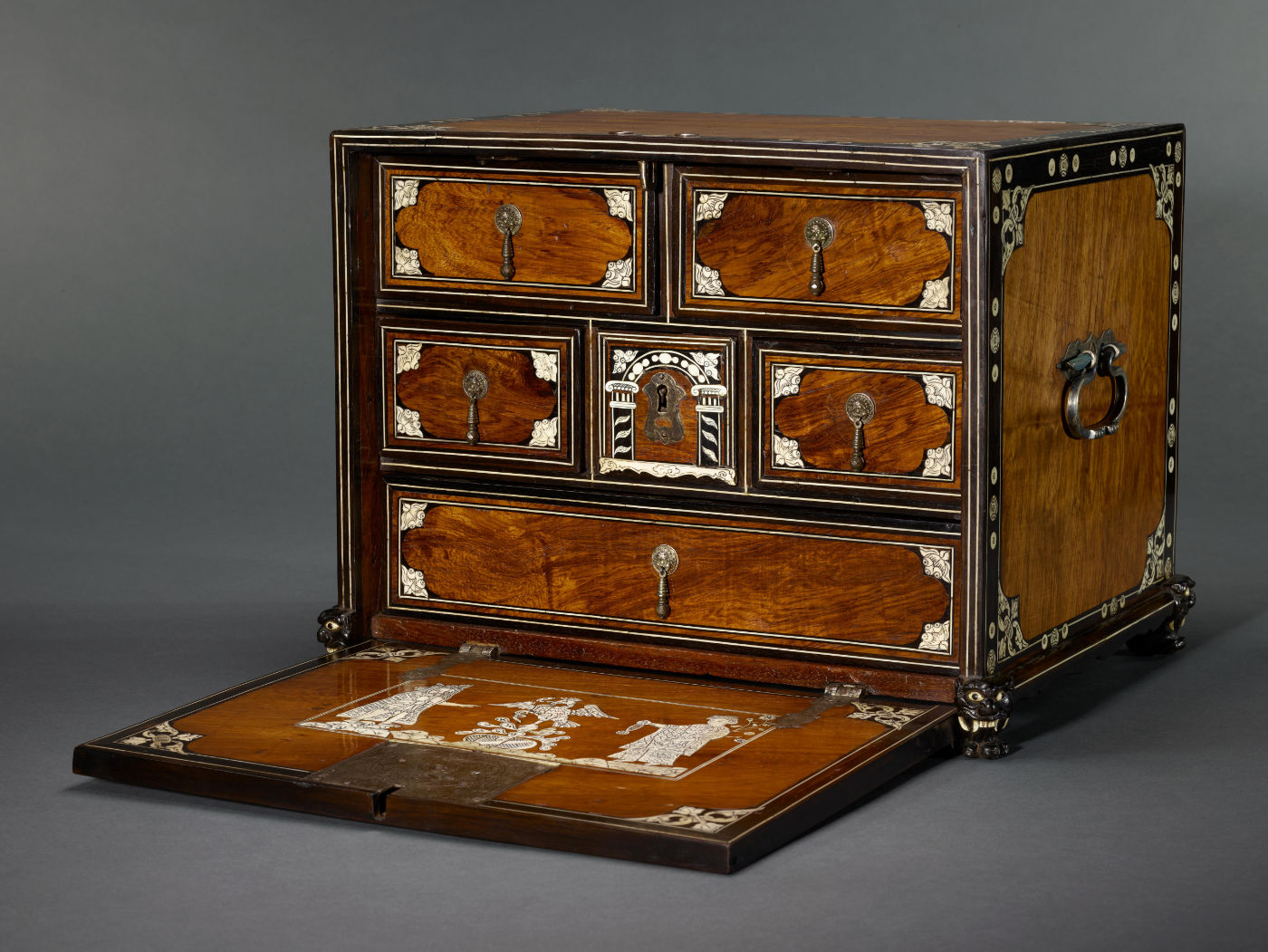
Singapore’s Asian Civilisations Museum collection features an unusual small wooden writing cabinet that can be closely associated with some ten other cabinets and chests.1 The group exhibits an intriguing combination of influences: The form of the fall-front writing cabinet became popular in Europe during the late Renaissance, while the stylistic features of the carving and inlay point to a Chinese source. Moreover, these cabinets are fashioned out of tropical hardwoods found in Southeast Asia. This rich combination suggests that the cabinets were made in a colonial port city in Southeast Asia, almost certainly Manila in the Philippines in the late seventeenth and eighteenth centuries.
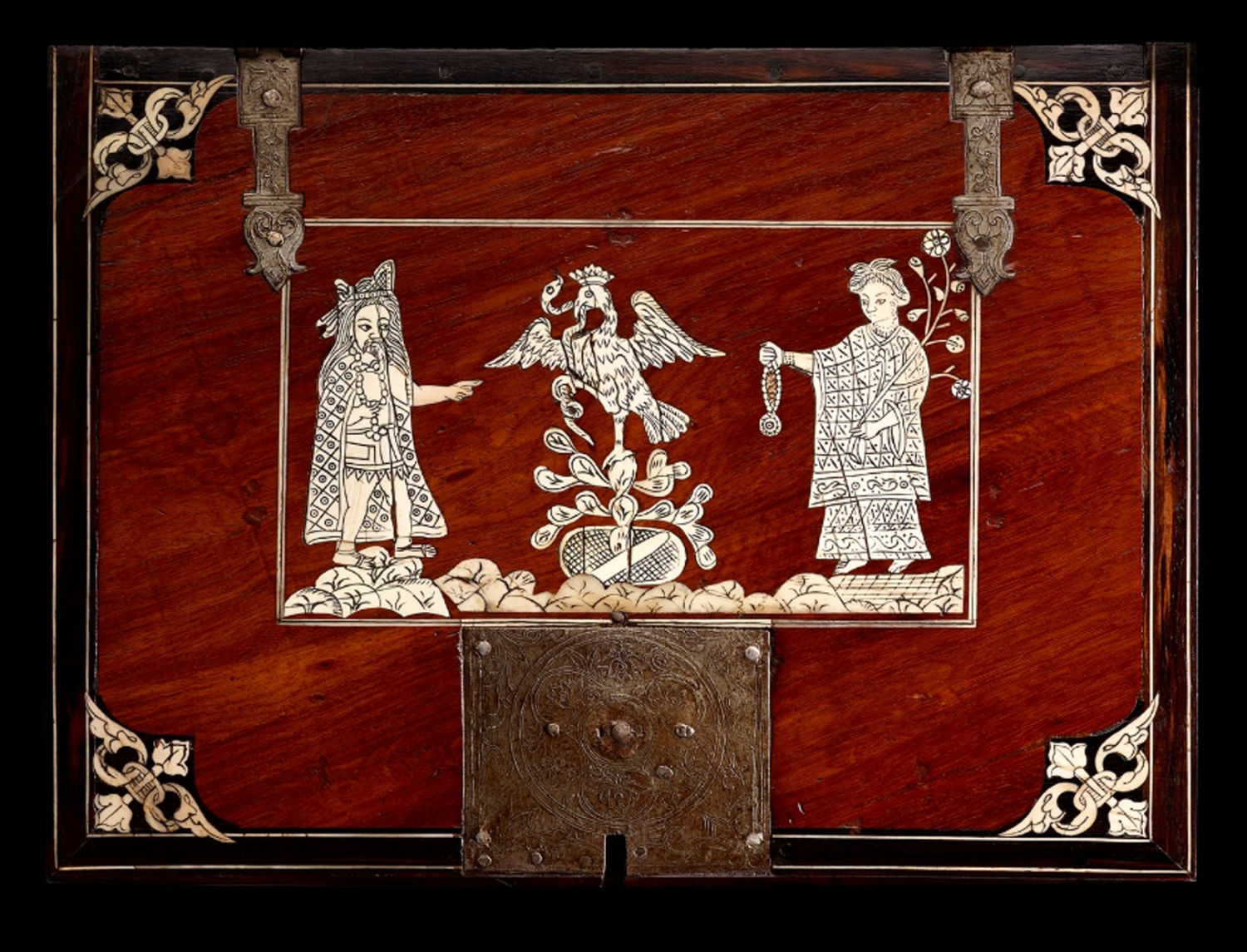
The Singapore cabinet in particular adds yet another cultural connection: the Americas, for the inlay decoration on the interior surface of the fall front depicts the founding myth of Tenochtitlan, the capital of the Mexica people (fig. 1). A crowned eagle perches on a nopal cactus, which grows out of the Nahuatl glyph for water (atl). The eagle holds a snake in its beak. This famous symbol of the Mexica became the emblem of what would become Mexico City. Therefore, the cabinet was probably commissioned by or for a dignitary in New Spain.
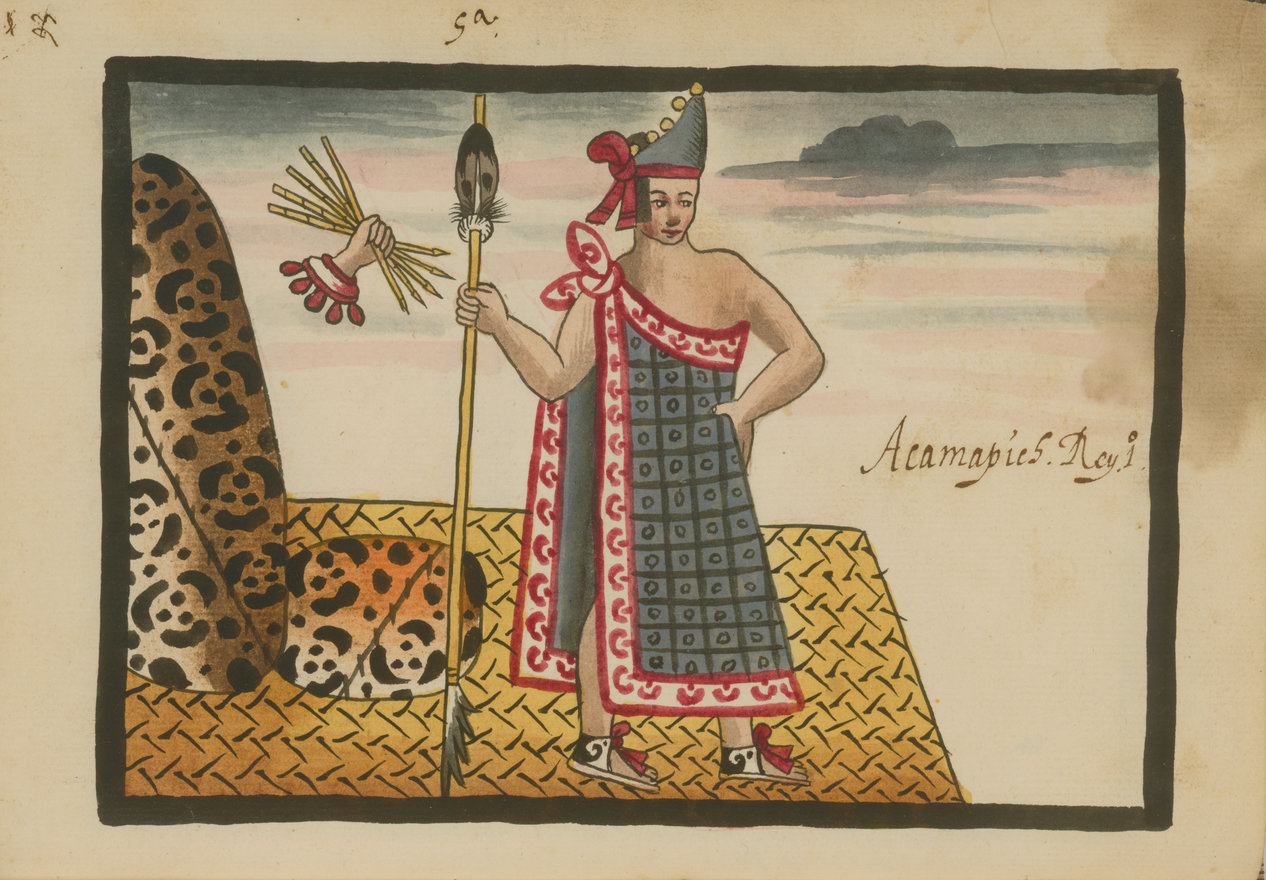
Details of the decoration suggest that the patron had a sophisticated knowledge of not just Mexico City but Tenochtitlan. At the left of the composition, a nobleman with a beaded necklace points to the bird (fig. 2). His attire resembles that seen in an illustration of Acamapichtli, the first tlatoani (ruler) of the Mexica and founder of the imperial dynasty (fig. 3). On the right, a noblewoman gestures toward the eagle with a necklace in her right hand while holding a flowering branch in her left.
While the basic form of these portable writing cabinets is European, imaginative design variations connect them with Chinese furniture-making in the Philippines. Several features can be found in Chinese furniture, including the beast mask, claw-and-ball feet at the corners, scalloped apron at the lower front, and drawer pulls with lion heads.2 The inlaid decoration touches on several cultures: In addition to the figures and symbols from Mexica history, the floral bouquets in the four corners are commonly encountered in European art. Although only the Singapore cabinet has a specifically Mexican motif, it seems that other examples from this grouping may also have been made for export to New Spain.
The Convergence of Global Goods in Multicultural Emporiums
Beginning in the late fifteenth century, advances in navigation and ship technology opened new routes between Europe and Africa, Asia, and the Americas. Large vessels carrying substantial cargoes could now sail thousands of miles, which allowed for the rapid expansion of trade, military conquest, and the spread of Christianity, often with tragic results for the Indigenous peoples of the world. As this new trading system established outposts in distant lands, people from various cultures gathered and mingled. Indeed, global trade depended on networks of port cities that became vibrant hubs for the exchange of people, goods, technology, and art.3
The transpacific galleons that carried goods and people between the Philippines and Mexico were controlled by the Spanish Crown, which regulated ship construction, the nature of the shipments, and their sale in Mexico. The cargoes were sold in Acapulco and transported overland to Mexico City. Some goods continued on to Veracruz, the port in the Caribbean, where they were shipped to Spain or Spanish-controlled cities in the Americas. The Manila–Acapulco Galleon trade lasted from 1565 to 1815, with its heyday in the seventeenth and eighteenth centuries. The ships, which could sail only once a year in each direction, were Spain’s only link to Asia, since the route around Africa was mostly controlled by the Portuguese and later by the Dutch and British. The Spanish depended on the safe crossings of the galleons not only for profit but for their political survival in the Philippines.
The galleons made Manila one of the world’s most vibrant ports, drawing traders from China, Spain, Mexico, India, and indeed the entire world. In 1662, the Franciscan monk Bartolomé de Letona wrote that “the variety of nations seen in Manila and its surroundings is the greatest in the world; one finds peoples from all the kingdoms and nations, for example, Spain, France, England . . . from the West and East Indies, Turks, Greeks, Persians, Tartars, Chinese, Japanese, Africans, and Asians.”4 Nearly a century later, the Jesuit friar Pedro Murillo Velarde (1696–1753) remained impressed by Manila’s diversity: “Not one colony, of all those founded by Europeans in Asia and Africa, equals it in greatness, wealth, abundance, and community. . . . The meeting of various nations—I do not think there is anything like it in the world.”5
While trade linked Asia and Mexico, it was the interaction of individuals at all levels of society that generated an eclectic material culture. Although the vast majority of surviving Mexican and Philippine colonial art is religious in nature, secular art was also produced for every aspect of colonial society. Elite households in Spain, Portugal, and Mexico often mingled Spanish, Flemish, Italian, German, and Asian furnishings. 6 Contemporary portraits of wealthy individuals display an array of global objects that flaunt their wealth, influence, and sophistication. In Asia, inventories of the multicultural residents of Malacca and Batavia (present-day Jakarta) reveal that individuals accumulated belongings from Europe, China, Japan, Myanmar, Sulawesi, Java, Sri Lanka, and India, among other places.7 The inhabitants of Manila were no different, and by the late sixteenth century, goods converged there from all over the world.8
Philippine Furniture
The Manila galleons primarily carried Chinese goods to Mexico and beyond. For example, the inventories of ships from 1565 to 1576 (Caja de Filipinas or Contaduría) regularly list porcelain and silk.9 From the mid-seventeenth century, records of porcelain entering and leaving Cavite, the main port of call in the Philippines, diminish significantly, perhaps because export porcelain was reclassified as private trade and would not have appeared in official records.10 Moreover, contraband and the falsification of ship registries were common throughout the history of the galleons.11 Furniture is nearly absent from galleon records: Isolated examples may have escaped the attention of officials and in any case were not described in detail.12 Most cabinets and chests were likely regarded as functional objects meant to transport other commodities, or perhaps they were classified as personal effects to avoid tax.
References to furniture can be found in colonial estate inventories and wills, which sometimes suggest Asian origin. Early Spanish accounts of the Philippines report that there was very little furniture in Filipino residences.13 Only after a period of Spanish rule did Indigenous life incorporate more European-style furniture in interiors. In fact, most terms used in the Philippines for furniture are derived from Spanish: A chair is a silya, from the Spanish silla; a table is a mesa, and so forth. However, the lack of documentation for most surviving examples of furniture in the Philippines makes it impossible to identify individual furniture makers during the seventeenth and eighteenth centuries, whether Chinese immigrant (sangley) or local Filipino artists or collaborations between them.
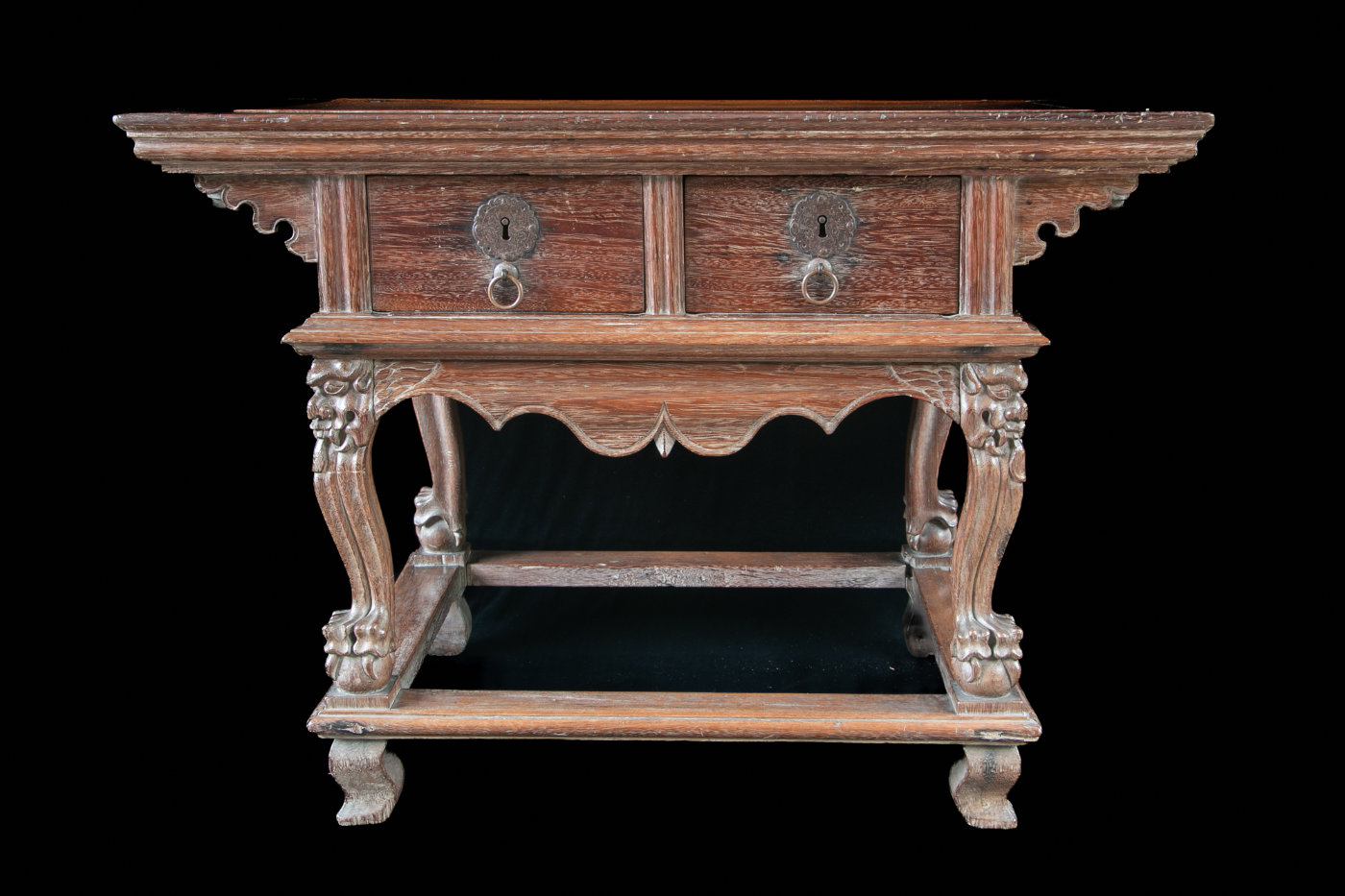
Chinese styles and techniques were gradually integrated with local motifs to create hybrid forms, with many motifs being shared across Asia and Europe along the trade networks. One distinctive cross-cultural creation of the Philippines is the altar table (fig. 4). This type of table was commonly used in churches and homes for the display of offerings and religious figures. Early examples like the one in figure 4 resemble Chinese tables, with curving legs that end with paws grasping balls. Beast masks with long tongues perch atop each leg. Wide stretchers connect the legs to provide stability, while the short feet protect the furniture from moisture. Aspects of this design can be found in furniture made in China, Europe, and Southeast Asia. The balayong tree (cassia) from which the wood comes is native to the Philippines. In the seventeenth century, three regions were known to produce Philippine furniture: Bohol, Baliuag, and Batangas. The latter two regions are noted for such altar tables. Gradually, the demand for these pieces spread to other regions, including Bicol, Mindoro, and Cebu.14
Early patrons of Philippine furniture were the clergy and Spanish officials who commissioned Chinese artisans to furnish churches, monasteries, and colonial offices. By the late seventeenth century, Chinese merchants and artists had started marrying into the local community. Despite racial prejudice and legal barriers, individuals of Chinese and Filipino descent came to dominate the production of consumer goods. New groups of affluent patrons moved beyond Chinese-inspired models for domestic secular furniture.15 Their requirements were naturally quite different from those of churches. By the late eighteenth century, Philippine furniture displayed Chinese and Spanish colonial features, together with local and other European details, all confidently integrated to create a uniquely Philippine aesthetic.
Records indicate that many woodworking shops were found along waterways. Furniture makers would have resided in the major trading towns, acquiring the lumber and distributing their finished products by water. Workshops in the province of Batangas were centered in the towns around Taal Lake: Calaca, Lemery-Taal, San Pascual-Bauan, and Lipa. Manila and central Luzon workshops could be found along the riverine settlements from Tondo-Malabon, Meycauayan-Marilao, Baliuag, Malolos, Calumpit, Apalit, Guagua, and the Pampanga river system all the way up to Nueva Ecija.16 These workshops flourished over several generations through a system of apprenticeship, while the more popular designs would have persisted over time, often taken up by other furniture workshops.
San Agustin Church, Manila
The collection of the San Agustin Church in Manila, much of which can be documented to the seventeenth century, exemplifies Philippine furniture. For instance, claw-and-ball feet emerging from beast masks and scalloped carving on the apron can be found in numerous pieces. Sometimes thought to have been made in Guangzhou and then exported to the Philippines, many of these pieces are made of tropical hardwoods, which points to an origin in the Philippines. Contemporary observers noted that there was a thriving community of Chinese furniture makers in Manila, who almost certainly collaborated with Indigenous artists.17
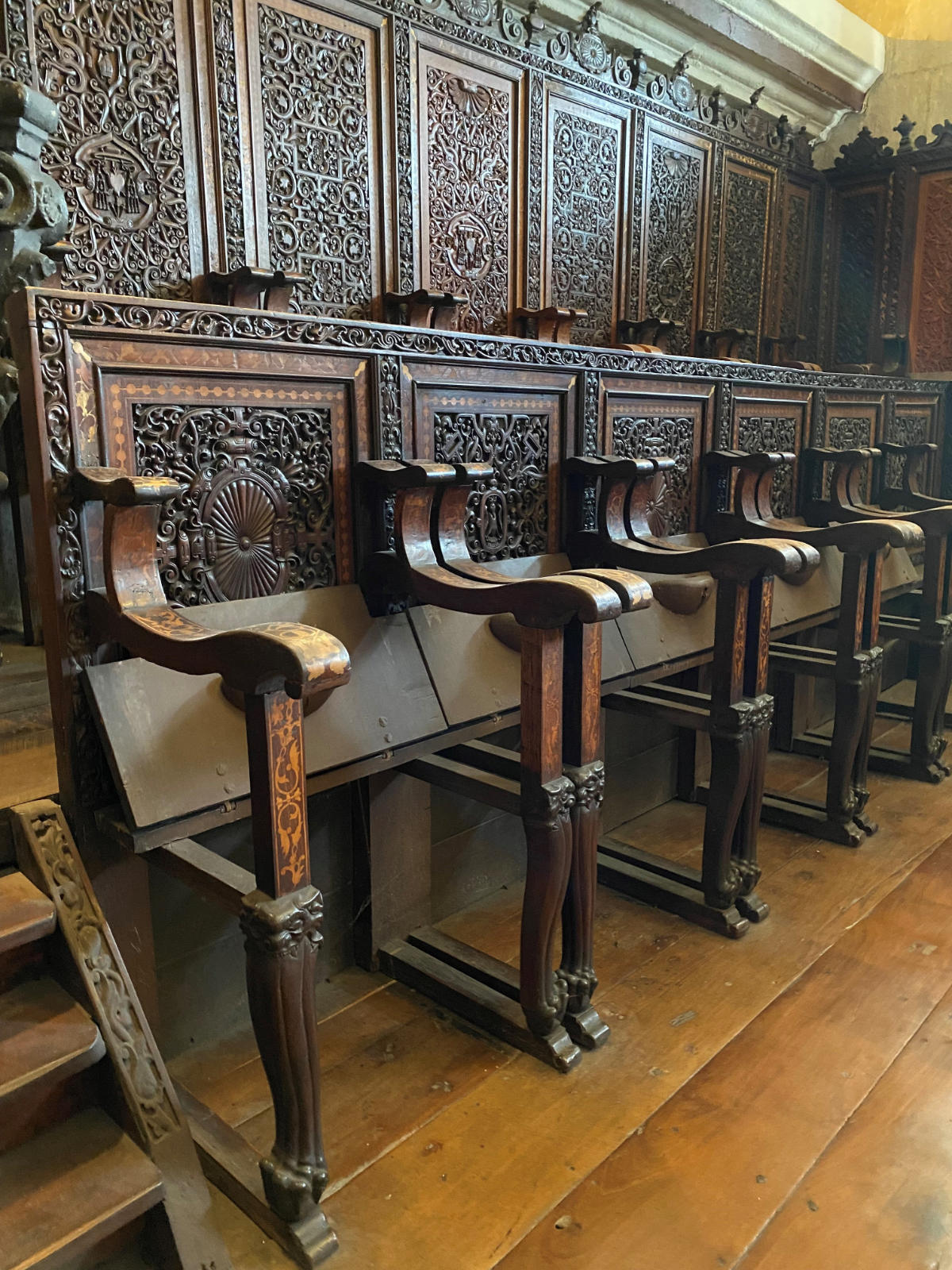
The church of San Agustin possesses numerous pieces of furniture adorned with Chinese motifs. The most spectacular of these are the sixty-eight intricately carved choirstalls commissioned by Miguel García Serrano between 1608 and 1614 (fig. 5). The strapwork motifs relate to late Renaissance design while the woods are kamagong with inlays of narra, both native to the Philippines.18 Interspersed among the decorations are the chrysanthemums common in Chinese and Japanese art, and cabriole legs emerge from beast masks and end in claw-and-ball feet.
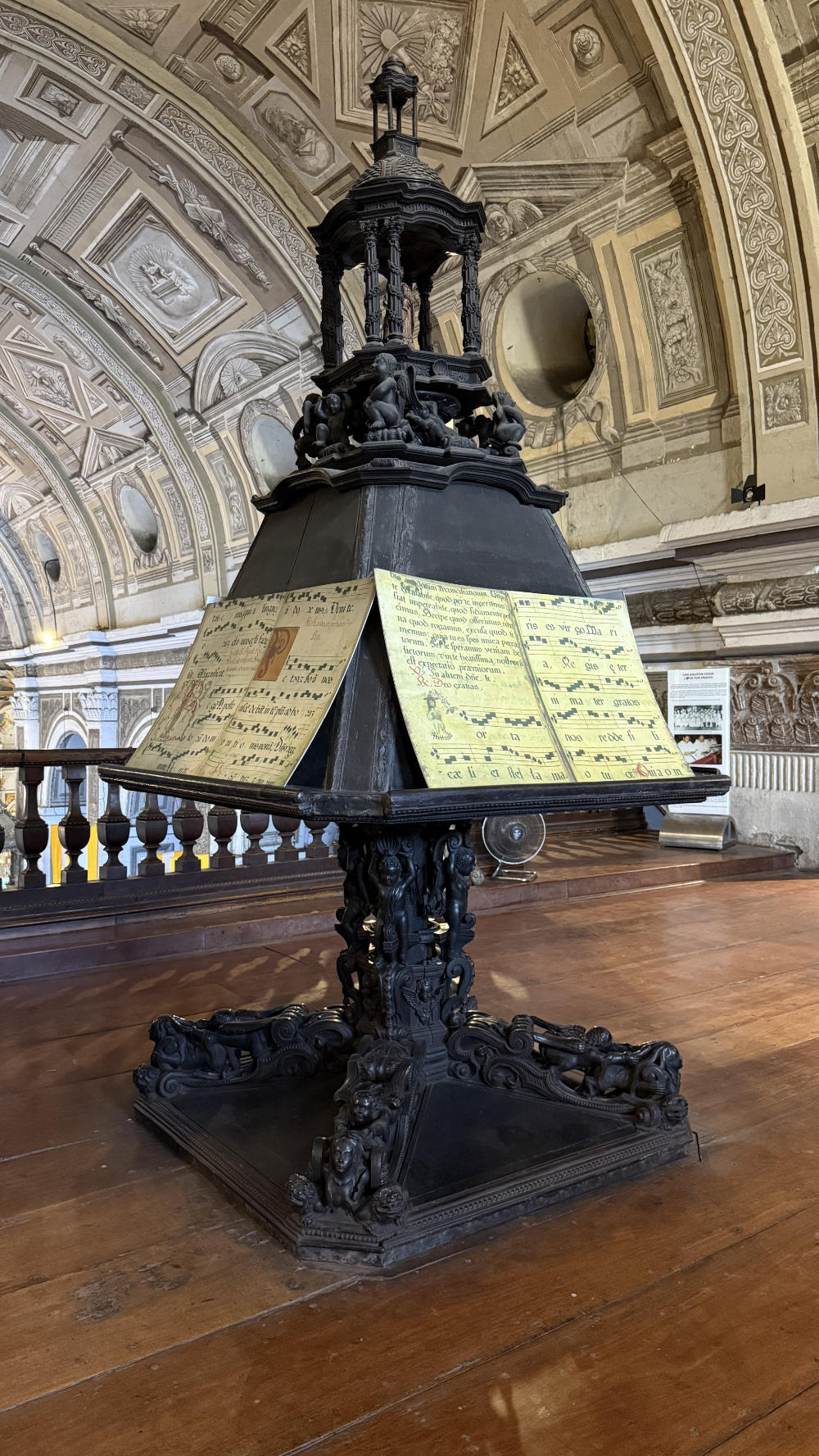
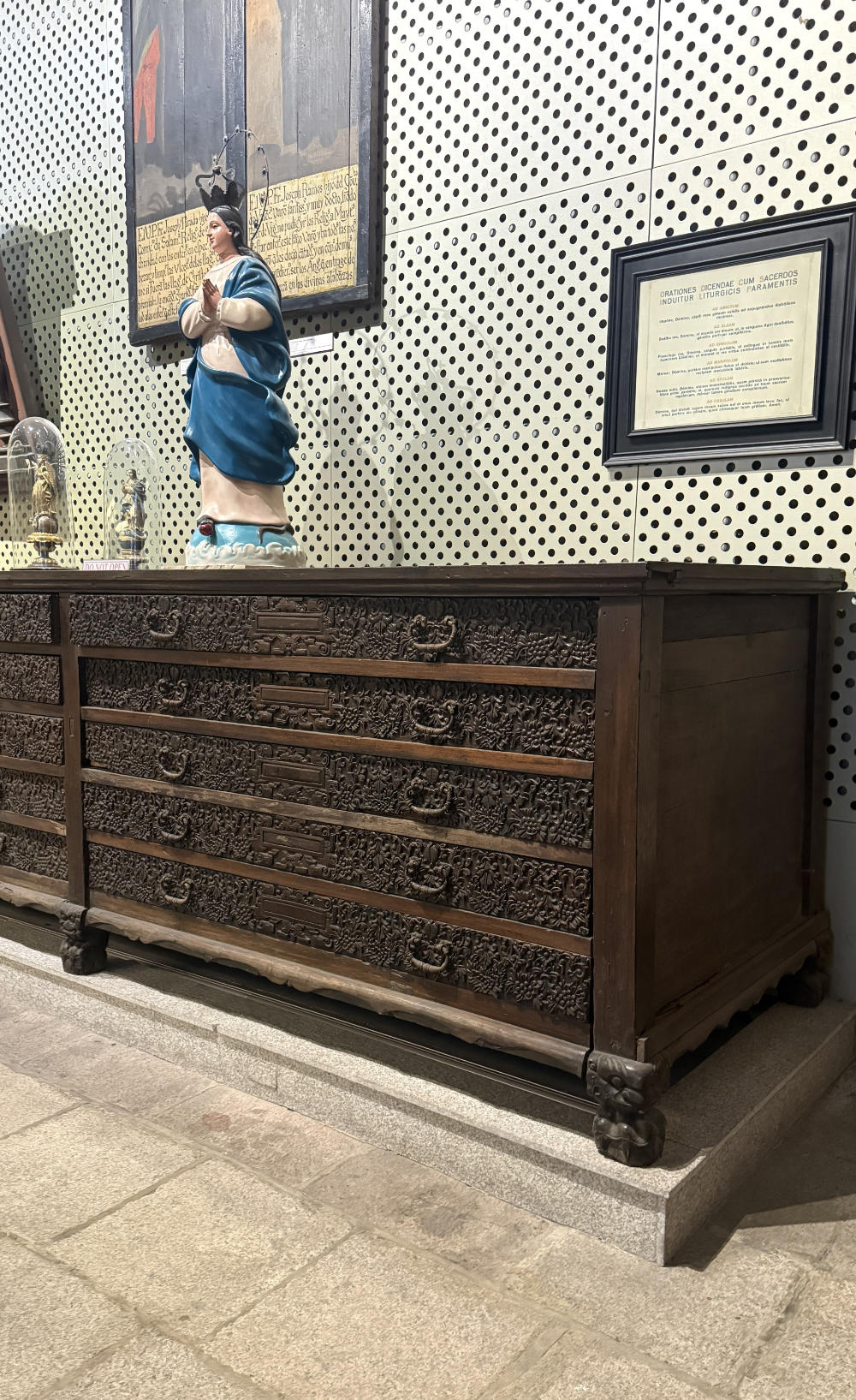
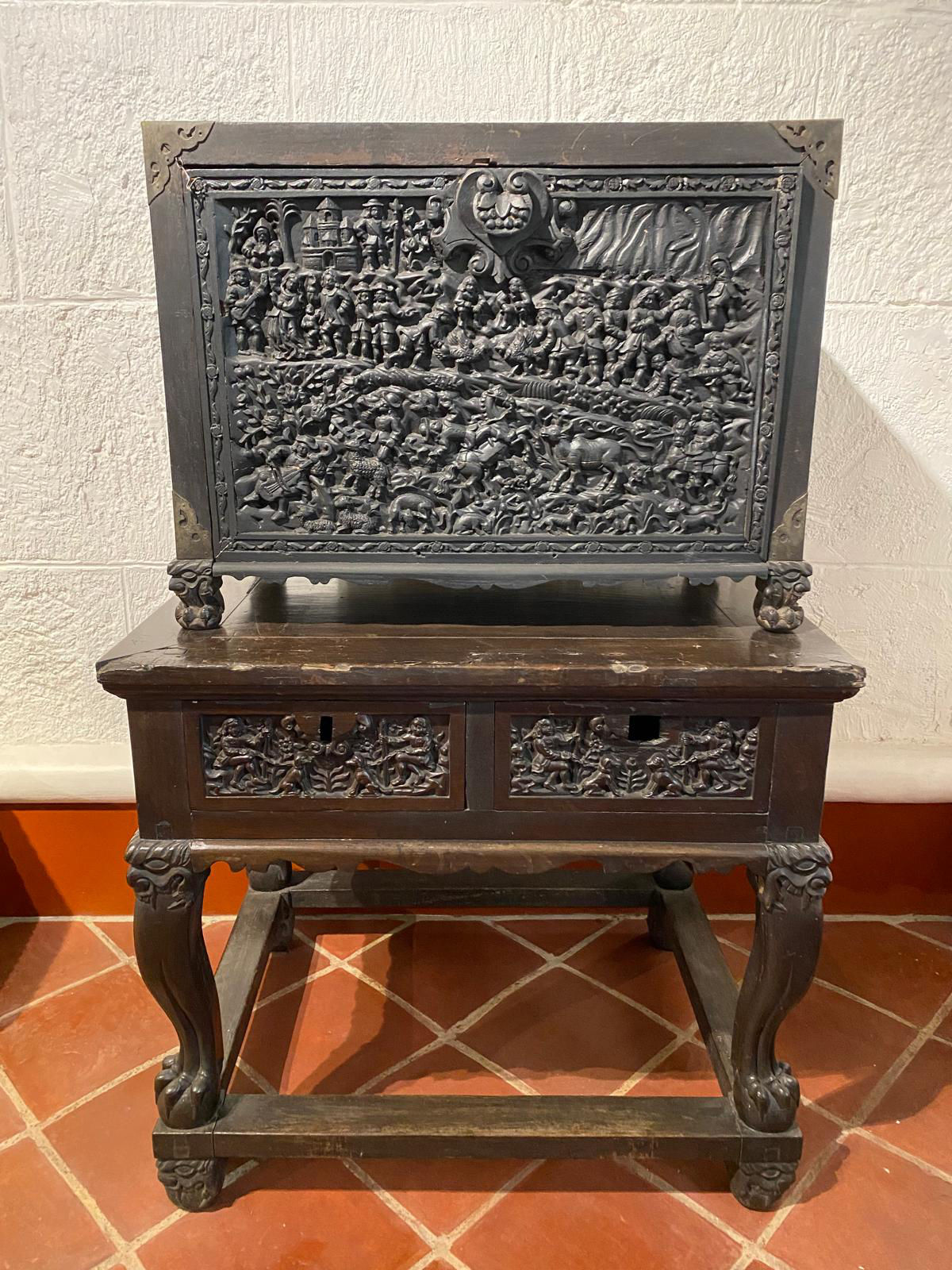
The large lectern in the choir loft of the church of San Agustin is said to have been commissioned by Félix Trillo around 1728–34 (fig. 6). The lower part of the choir lectern is a curious mix of motifs, amalgamating Christian figures such as cherubs, angel heads, and Augustinian hearts pierced by two arrows with Western female figures, Chinese mythical guardian dogs, and scrolling clouds. Another choir lectern, in Mexico City Cathedral, was carved out of tindalo, a Philippine hardwood, and presented in 1762 by the archbishop of Manila, Manuel Rojo del Río y Vieyra.19 It is likely that these examples were produced by Chinese furniture makers in Manila. Within the sacristy of San Agustin, long cabinets (cajonerías) line both sides of the hall (fig. 7). These cabinets store liturgical vestments of the priests. The cabinets rest on beast masks with paw feet; the drawers are carved in rich floral reliefs. The massive furniture in this room was commissioned by Dionisio Suárez between 1653 and 1674.20 A pair of fall-front cabinets, richly carved in dark hardwood with relief scenes, also bear beast masks and claw-and-ball feet (fig. 8). These examples help to relate the Singapore cabinet to its larger group.
Writing cabinets enjoyed considerable popularity from the sixteenth to the eighteenth centuries. Essentially a small chest of drawers, they had hinged front panels that could be lowered for use as a writing surface. When the fall front is closed, the cabinet could usually be locked for transport or to secure valuables. These intimate pieces of furniture invite close inspection and are often elaborately decorated. As demonstrated, furniture makers in the Americas and Asia contributed new motifs and materials to the genre, especially through the use of rare hardwoods and exotic materials such as ivory, tortoiseshell, and mother-of-pearl. Lacquered cabinets made in China and Japan were exported to the Americas and Europe, and decorative schemes were borrowed from the symbolic systems of China, Renaissance Europe, and Mexico to delight connoisseurs. Specialized forms of art developed along the trade routes, from China—which for centuries had tailored its products specifically to consumers in other cultures—to the Philippines, Mexico, and the rest of the Americas. Many of these works had multiple connections to European and Indigenous artistic traditions, which changed over time.
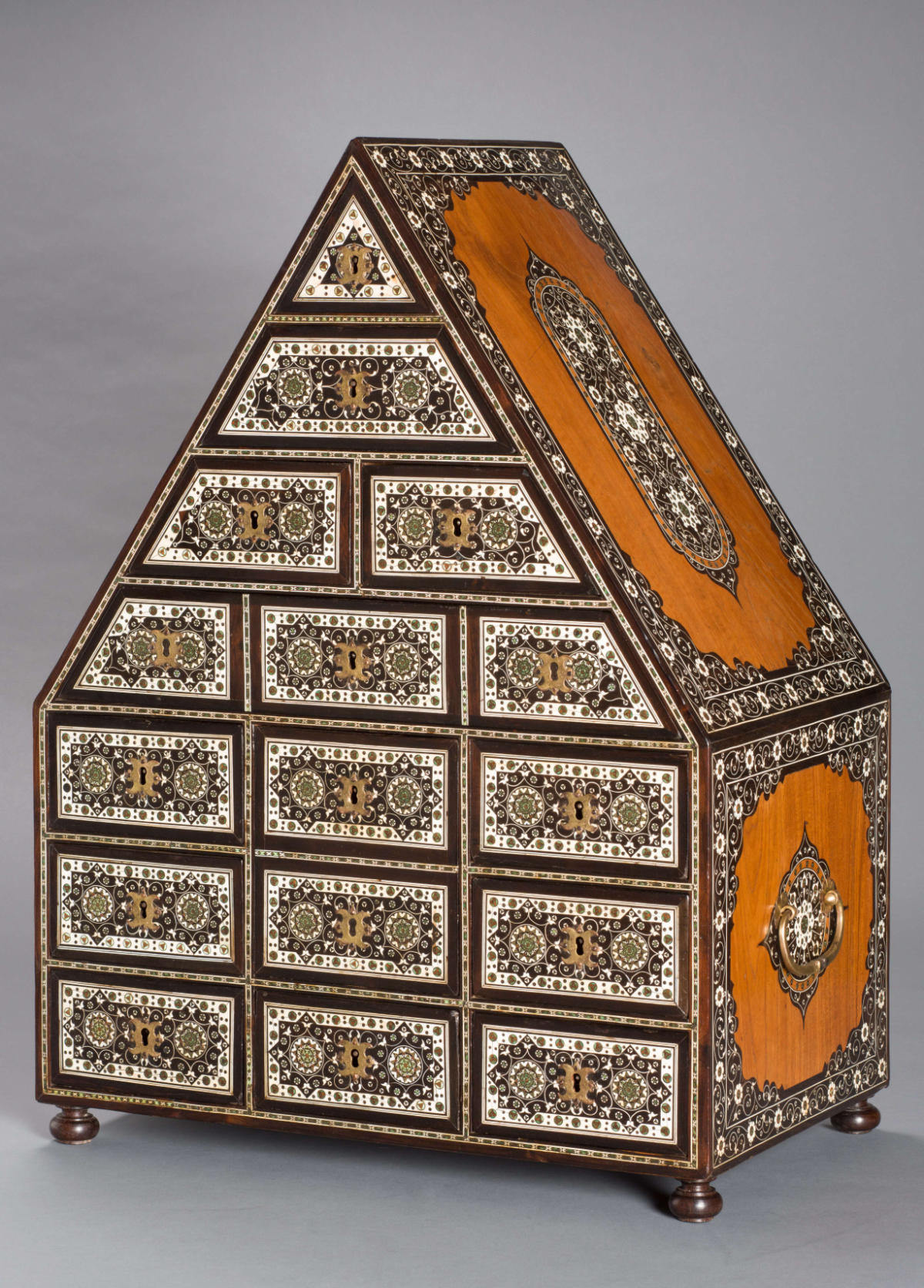
A distinguishing feature of these Philippine cabinets is that the inlays are usually bone rather than ivory. Contemporary pieces made in the Indian regions of Gujarat and Sindh for the Portuguese market and in Agra for the Mughal court commonly employed ivory for inlay decoration (fig. 9). Ivory was not especially rare in the Philippines as it was extensively used for religious sculpture, but it may have been regarded as more appropriate for sacred images, which in turn discouraged its use on secular furniture. There may also have been a more pragmatic reason: Bone was cheaper and more widely available. In Spain’s Nasrid period (1232–1492), artists in Granada often mixed ivory and bone in their inlaid furniture, and this practice may have also been used in making Spanish colonial possessions.21 Both ivory and bone were typically shaped, carved, engraved, or pyrographed before being inserted into a wood support. In Baliwag (Bulacan), one of the well-regarded furniture-making towns of the Philippines, were many water buffalo slaughterhouses. The abundant supply of bone might have produced a secondary craft industry of bone inlay to decorate furniture.
An Identifiable Workshop?
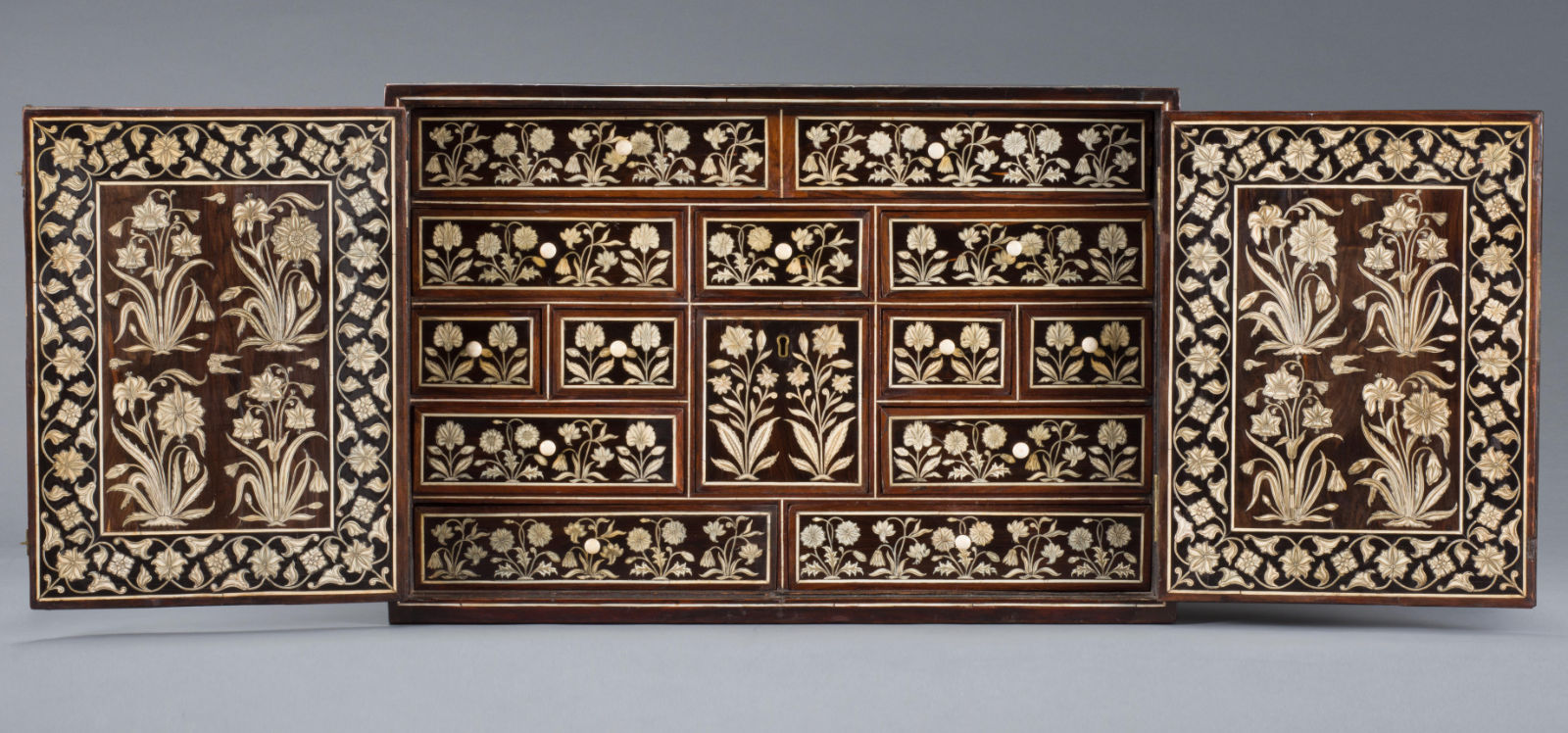
Though the work in the Asian Civilisations Museum collection is European in form, the object resembles the fine inlaid furniture produced in India for the Portuguese (fig. 10) or even cabinets made in the Americas. However, this example was made in the Philippines.
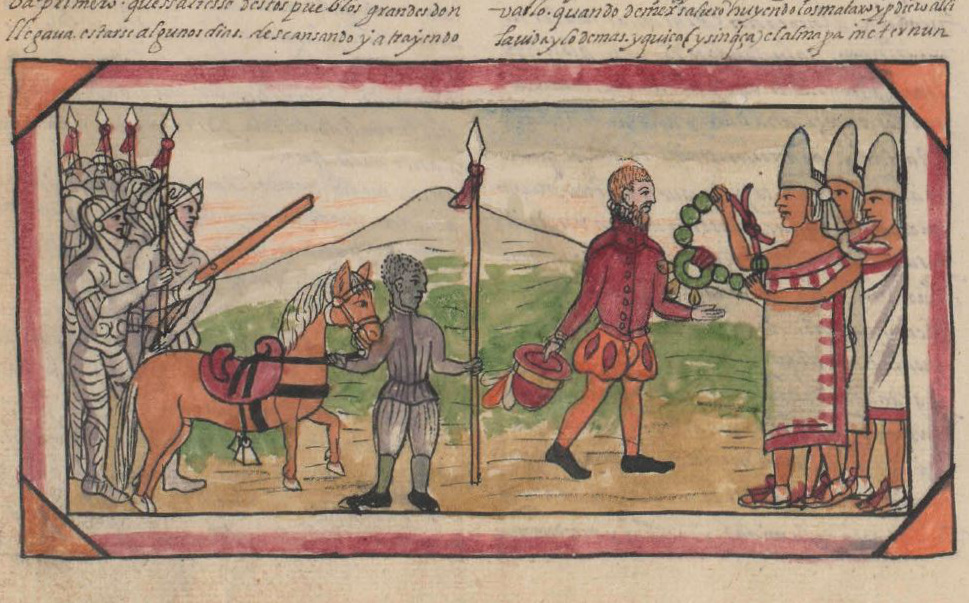
As mentioned, the inlay decoration shows the foundation myth of Tenochtitlan. It is unusual to find such Mexica imagery on a European-style, fall-front cabinet made in the Philippines. The motif of the crowned eagle perched on a flowering cactus is a common one. However, the two flanking figures are more unusual and suggest a specific source in a Mexican codex. The woman on the right stands on a platform, while the man opposite stands on rocky terrain. This alludes to the higher status of the noblewoman. The beaded necklace held by the noblewoman can also be seen in the Durán Codex (1579), where Hernán Cortés meets a local leader on the way to Tlaxcala (fig. 11). A similar beaded necklace was presented, probably as a gift to Cortés by the local chief. In the context of the cabinet, this necklace appears to be a gift of welcome.
The small central drawer is inlaid with an arch supported by serpentine columns, a familiar European motif, although the forms have been somewhat abbreviated. The four supports are carved with beast masks over claw-and-ball feet, a southern Chinese motif, as already discussed. This suggests that this cabinet was produced by Chinese artists working in the Philippines. Many of these cabinets and chests are decorated with an abstract motif at the corners consisting of two birds joined together—reminiscent of the double-headed Habsburg eagle but with a whimsical flavor since they resemble an abstract flower. The double-headed eagle was a symbol of the Habsburg dynasty, which ruled the Spanish empire between 1516 and 1700. It became extremely common in decorative elements around the world.
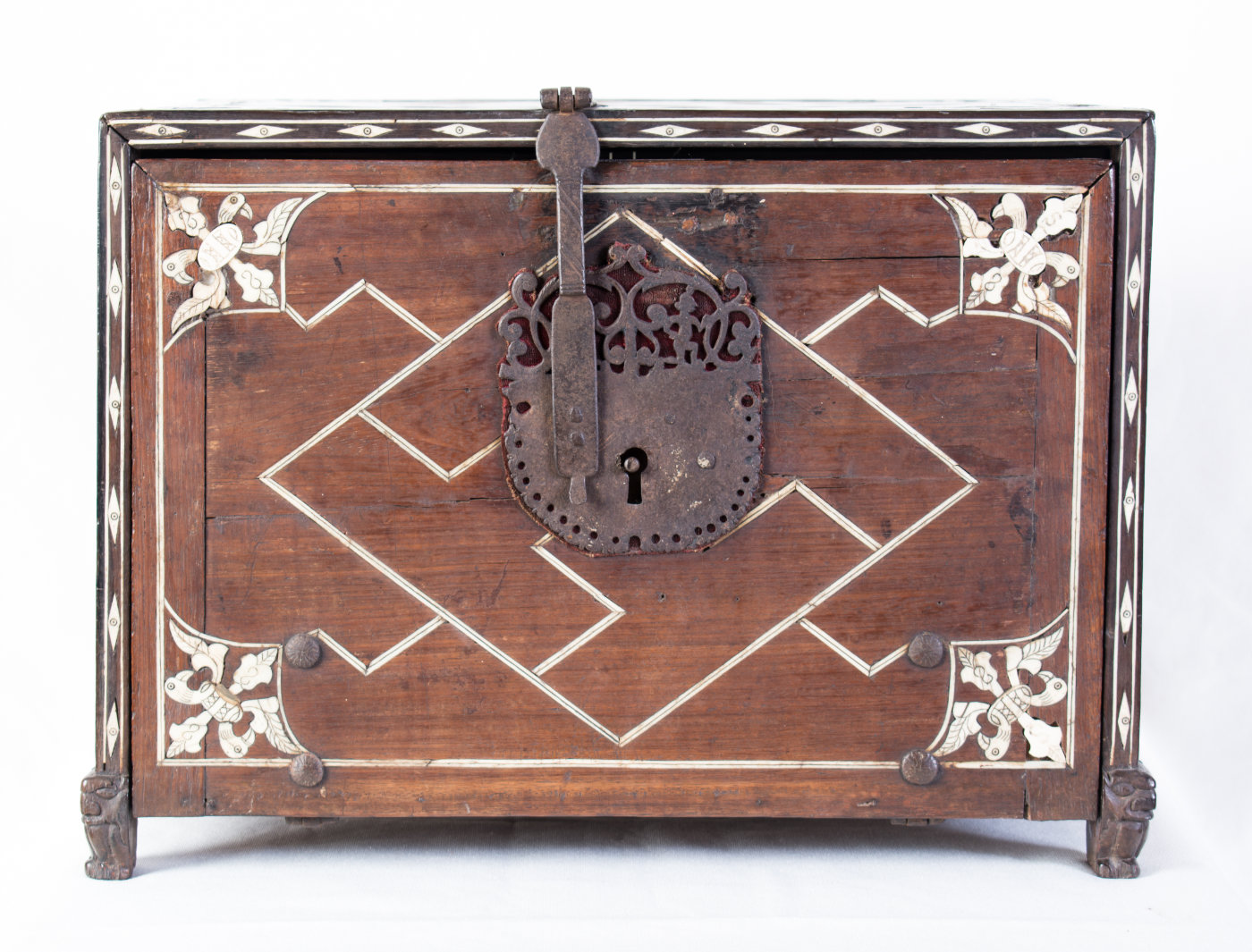
The front of the writing cabinet is decorated with a diamond intersected by angled lines that form a swastika-like pattern. This motif, which recalls Chinese patterns, can also be found on other writing cabinets of the group (fig. 12 and those in the collections of the Museo Soumaya and the family of Mr. and Mrs. Lee Kip Lee) but is otherwise absent from furniture of this period, suggesting that these pieces were produced in a single workshop.22
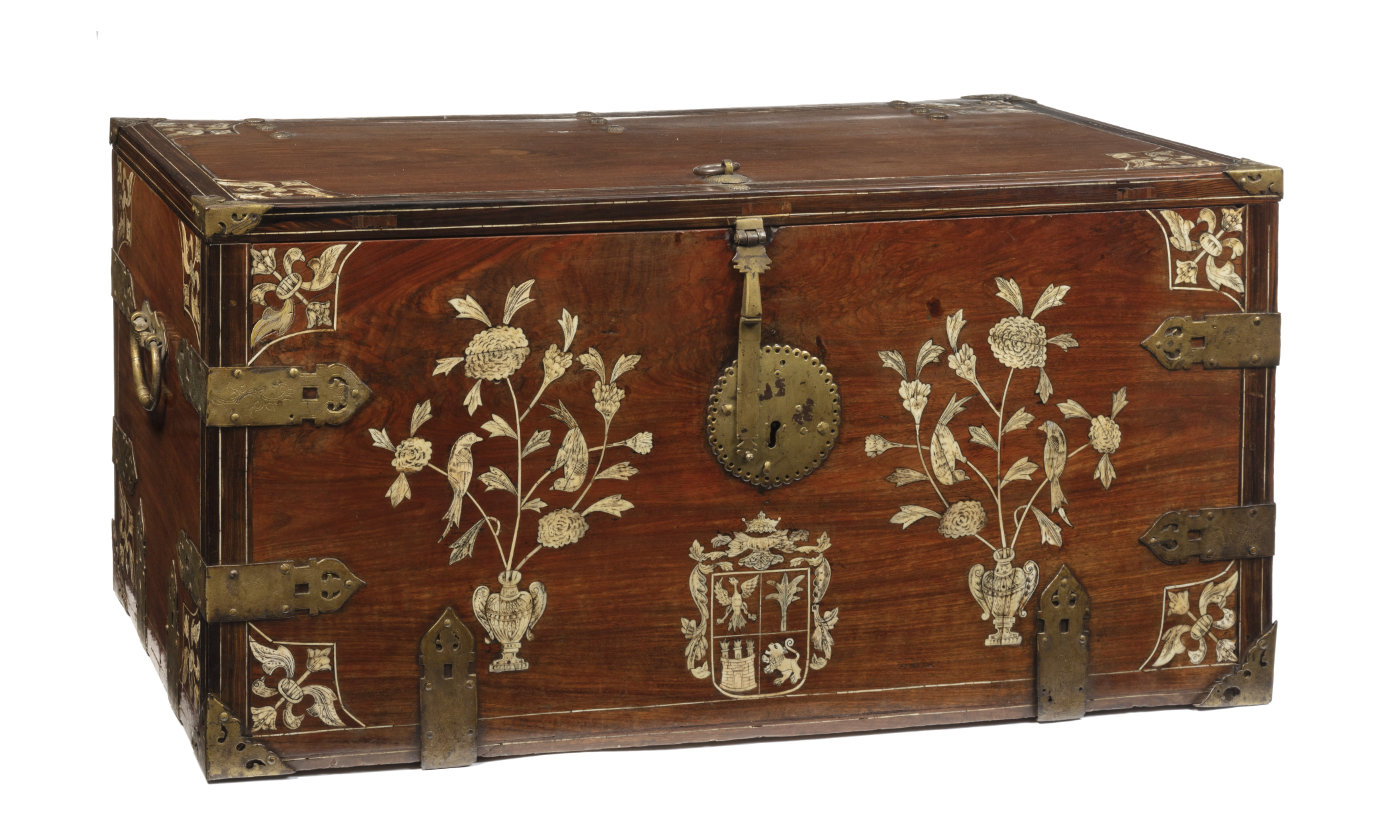
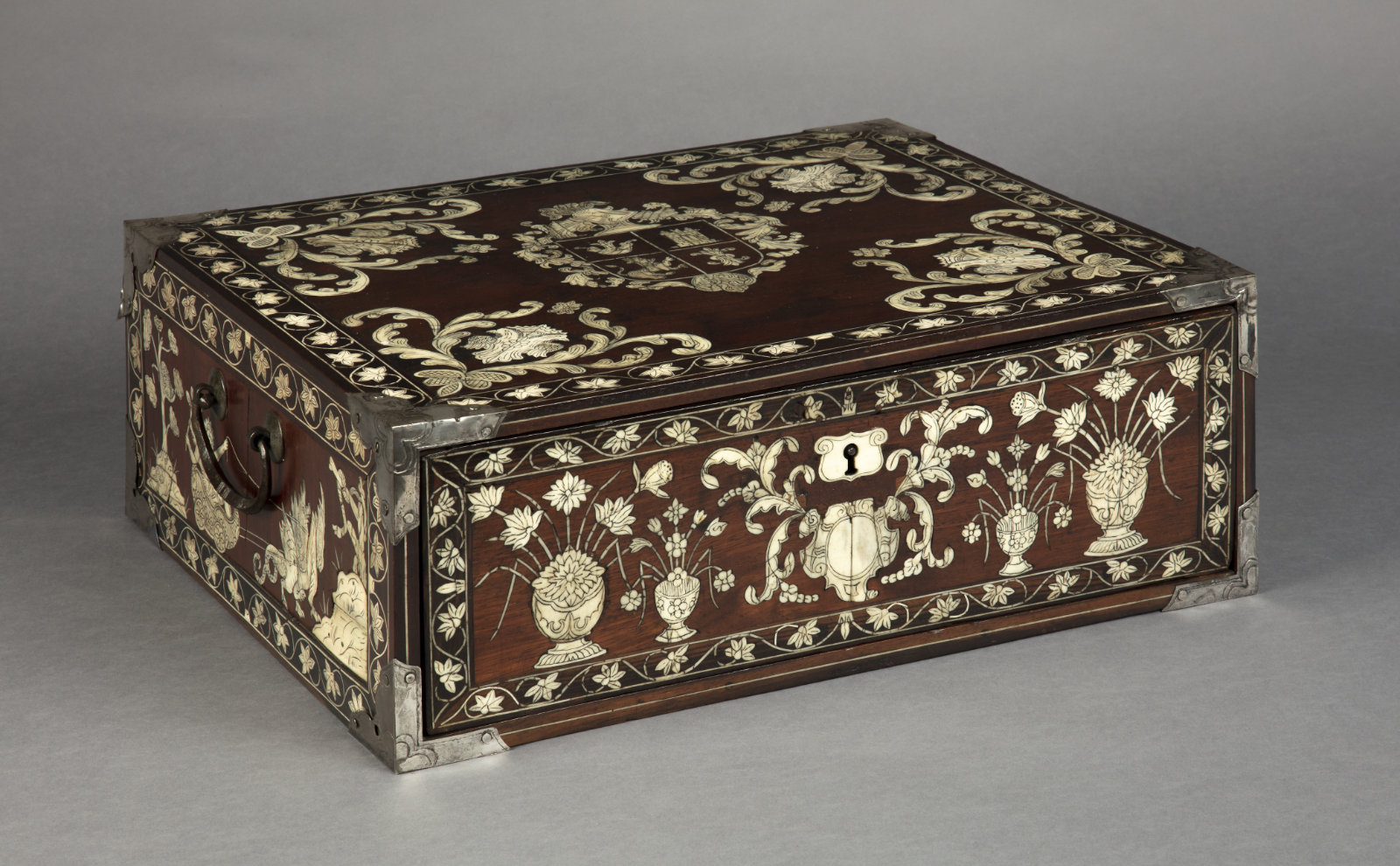
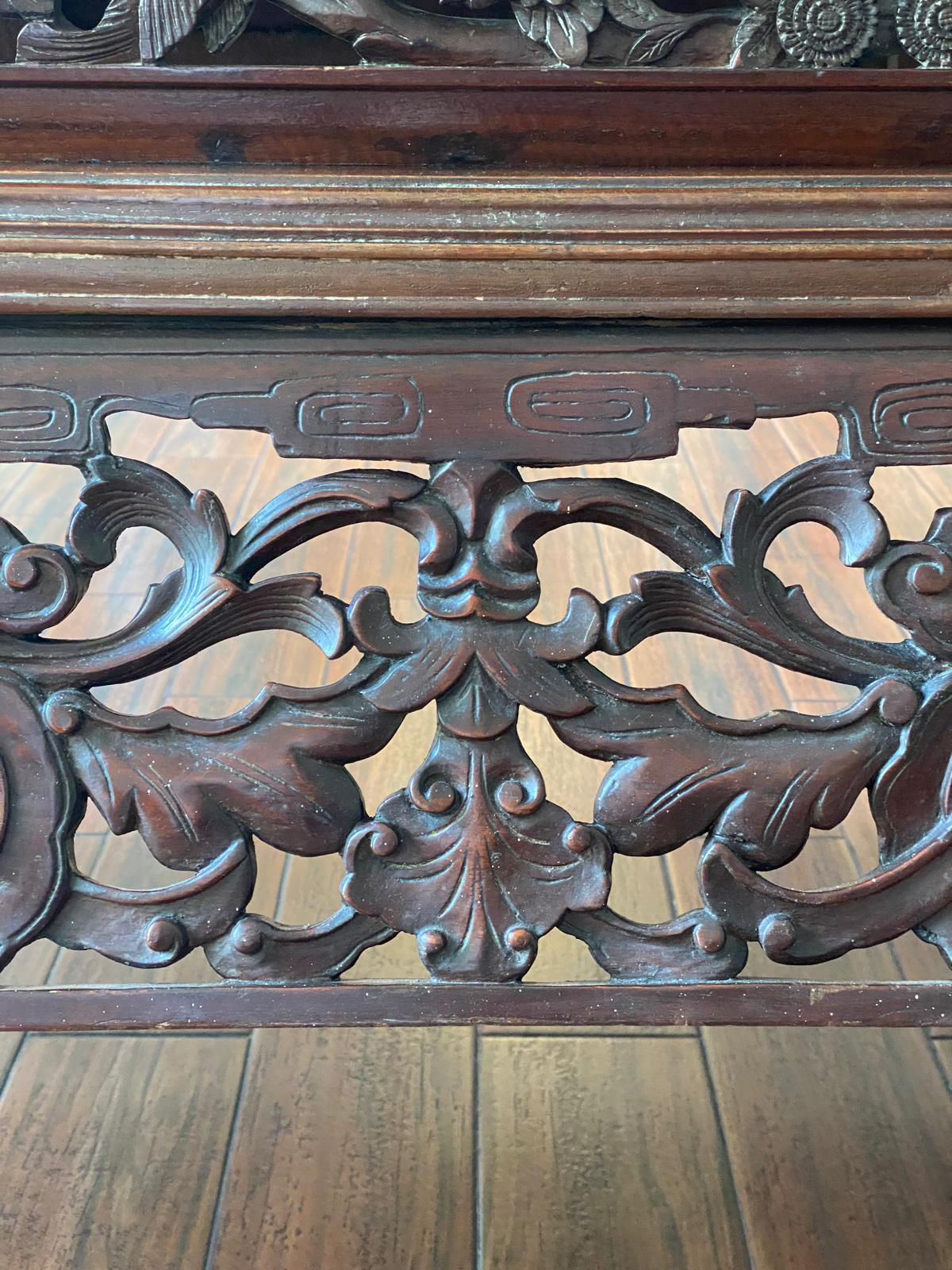
These closely related cabinets were probably special commissions from important individuals. For example, a chest in the Museo Franz Mayer is decorated with an unidentified coat of arms, surmounted by a three-pointed coronet that identifies the patron as a viscount (fig. 13).23 The escutcheon is flanked by two vases filled with flowers and pairs of birds resting on the stalks. At the corners are the floral elements from the Singapore cabinet, though here they are even more explicitly birdlike. Another cabinet in the Museo Franz Mayer displays several cross-cultural elements (fig. 14). The sides show chariots drawn by winged dragons, a European Renaissance motif, perhaps transmitted via a print or drawing. The scrolling vine and flower border resembles a design popular on Chinese blue-and-white porcelain and Indian chintz, which also appears in Mexican talavera blue-and-white ceramics. On the lid is an unidentified coat of arms, while the corners are decorated with double-headed birds surmounted with a crown and surrounded by stylized acanthus leaves.24 This version is closer to the double-headed Habsburg eagle than the abstracted motif found on the other cabinets. In the Singapore cabinet, the motif no longer even resembles two birds but appears more like a fleur-de-lis bouquet, a motif also found on Philippine altar tables (fig. 15).
Extravagant Variations
Two impressive cabinets show close affinities with the examples discussed here but are decorated in a more opulent manner (figs. 16 and 17). Complex patterns of vines, figures, and fantastical animals were created by setting engraved pieces of bone into wooden panels. Both pieces share a characteristic type of segmented vine formed from interlocking C-shaped sections rather than the continuously flowing tendrils often found in European and Chinese designs. This type of decoration is quite different from the presumably earlier inlaid furniture made by Chinese makers in the Philippines, which is sparer in decoration and often has the double-bird motif (see figs. 1, 12–14). Most of these examples have claw-and-ball feet that emerge from beast masks and the scalloped apron. They have certain similarities with furniture made in India for the Portuguese market, for example, in the fine inlays and combination of European and Asian motifs.25
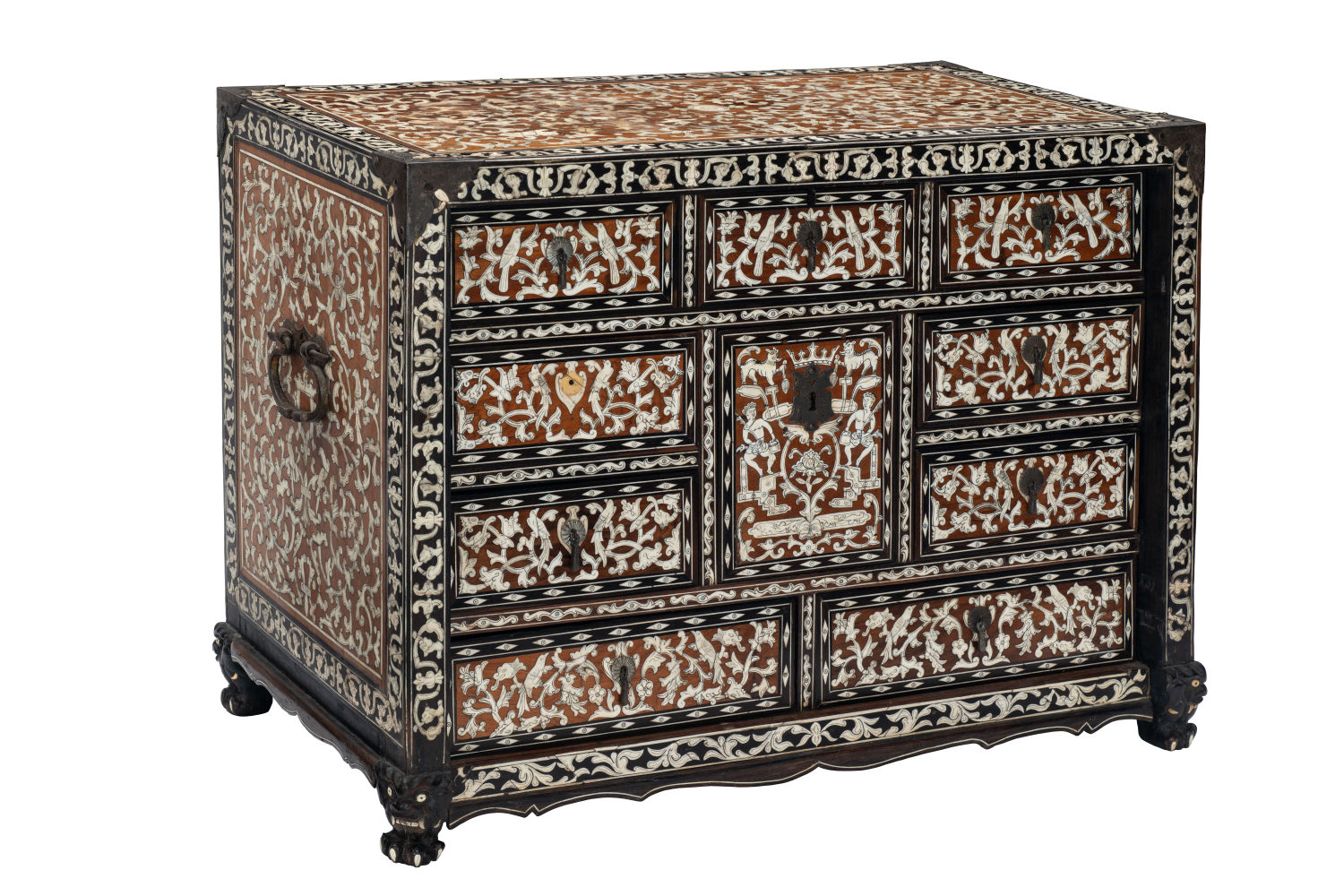
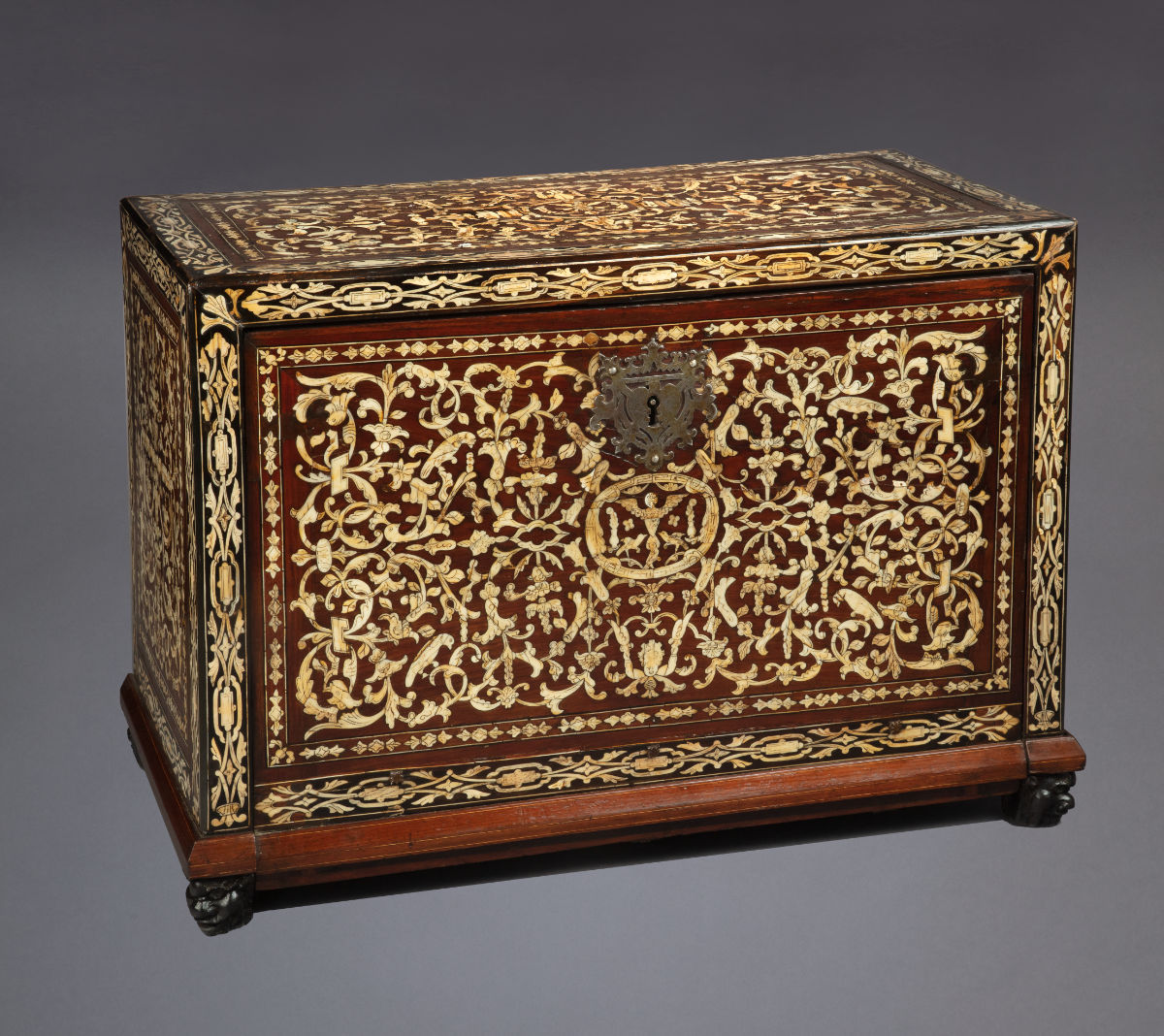
In a cabinet with ten drawers, the center drawer with a lock is decorated as though it were a coat of arms, with a crown above the metal lock plate, flanked by two lions holding fly whisks (fig. 16).26 Beneath the lock plate, male figures holding palm fronds and baskets flank a lotus flower. The combination of Chinese motifs, such as the lotus and lions, with European Renaissance nudes indicates that this cabinet was produced in a cross-cultural environment like Manila. Additional evidence indicates that the maker was Chinese: Most of the drawers are marked with Chinese characters indicating their positions: 東, 中, 西 (right, middle, and left), with additional indications of above and below, 上,下.
The top of this cabinet is decorated with vines from which two half-figures emerge. The lower apron of the cabinet may have been reconfigured to support a cover that is now missing. The original probably had neither a fall front nor a cover.
Another writing cabinet with a hinged front is densely inlaid with segmented vines (fig. 17). In the central oval medallion, a large bird spreads its wings, with two smaller birds to either side. This motif closely resembles the Christian symbol of a pelican piercing its breast to feed its young, representing the sacrifice of Christ. A new base was added to the cabinet, apparently using the original feet.
Given their shared materials and decorative schemes, could these inlaid cabinets, chests, and boxes have been produced by a single Chinese workshop in the Philippines? The variety of sizes, quality of inlay decoration, and the variations in decoration indicate that they did not constitute a single order for a client but multiple orders over a considerable period. It is very likely that some of them were commissioned for Mexico. Until documentary evidence is uncovered, the full histories of these objects remain a fascinating mystery.
Notes
-
In addition to the collections mentioned in the captions for figures 1, 12, 13, 14, 16, and 17, the eleven examples are in the Museo Franz Mayer, Mexico City; Museo Soumaya, Mexico City; the collection of Fernando and Catherine Zobel de Ayala; the collection of the family of Mr, and Mrs, Lee Kip Lee; and Aguiar-Branco Antiques, Paris. See Clement Onn, Alan Chong, and Bejamin Chiesa, eds., Across the Pacific: Art and the Manila Galleons, exh. cat. (Asian Civilisations Museum, 2024), 160, 162–67. ↩︎
-
The mask decoration has been called that of a lion, beast, ogre, or demon. Early collectors and dealers in the Philippines referred to this type of decoration as demonyo (Tagalog for demon) or dinemonyo. For this paper, the design is called the beast mask. ↩︎
-
Clement Onn, “Across the Pacific: Artistic Exchanges Around the Globe,” in Onn et al., Across the Pacific, 14. ↩︎
-
D. R. M. Irving, Colonial Counterpoint: Music in Early Modern Manila (Oxford, 2010), 32; the original text is on 245n29. ↩︎
-
Pedro Murillo Velarde, Geographia historia, de las Islas Philipinas, del Africa, y de sus islas adyacentes, vol. 8 (Madrid, 1752), 52: “Ninguna Colonia, de quantas han fundado los Europeos en el Assia, y Africa, le iguala en grandeza, en riqueza, en abundancia, y vecindario. . . . El concurso de varias Naciones, no creo tiene semejante en el mundo.” ↩︎
-
Jorge F. Rivas Pérez, “Domestic Display in the Spanish Overseas Territories,” in Behind Closed Doors: Art in the Spanish American Home, 1492–1898, ed. Richard Aste, exh. cat. (Brooklyn Museum in association with The Monacelli Press, 2013), 79. ↩︎
-
Peter Lee, Sarong Kebaya: Peranakan Fashion in an Interconnected World, 1500–1950 (Asian Civilisations Museum, 2015), 290–308. ↩︎
-
Etsuko Miyata Rodríguez, “Early Manila Galleon Trade: Merchants’ Networks and Market in Sixteenth- and Seventeenth-Century Mexico,” in At the Crossroads: The Arts of Spanish America and Early Global Trade, 1492–1850, ed. Donna Pierce and Ronald Otsuka (Mayer Center for Pre-Columbian & Spanish Colonial Art at the Denver Art Museum, 2012), 37–58; Peter Lee and Alan Chong, “Mixing Up Things and People in Asia’s Port Cities,” in Port Cities: Multicultural Emporiums of Asia, 1500–1900, ed. Peter Lee et al., exh. cat. (Asian Civilisations Museum, 2016), 30–41. ↩︎
-
Ibid., 42–43, citing Archivo General de Indias, Seville, Caja de Filipinas, 943–56. ↩︎
-
William R. Sargent, “Porcelains with the Arms of the Order of Saint Augustine: For New Spain? A Theory,” in Pierce and Otsuka, At the Crossroads, 57. ↩︎
-
Arturo Giráldez, The Age of Trade: The Manila Galleons and the Dawn of the Global Economy (Bloomsbury, 2015), 178. ↩︎
-
Jorge Loyzaga, “The Influence of Oriental Trade on Mexican Art, Culture, and Folklore,” in The Manila Galleon: Crossing the Atlantic, ed. Edgardo J. Angara et al. (READ Foundation, 2014), 94. ↩︎
-
Ambeth R. Ocampo, Cabinet of Curiosities: History from Philippine Artifacts (Anvil Publishing, 2023), 96. ↩︎
-
Ibid., 96–98. ↩︎
-
Ramon N. Villegas, “Mueblaje Filipino,” in Filipinos in the Gilded Age, exh. cat. (León Gallery, 2016), 158. ↩︎
-
Ibid. ↩︎
-
Pedro G. Galende and Regalado Trota Jose, San Agustin: Art and History, 1571–2000 (San Agustin Museum, 2000), 103. ↩︎
-
Ibid., 136. ↩︎
-
Ibid., 137. ↩︎
-
Ibid., 103. ↩︎
-
María Campos Carlés de Peña, A Surviving Legacy in Spanish America: Seventeenth- and Eighteenth-Century Furniture from the Viceroyalty of Peru (Ediciones El Viso, 2013), 90. ↩︎
-
For figure 12, see Onn et al., Across the Pacific, 164. The cabinet with the family of Mr. and Mrs. Lee Kip Lee is also adorned with elaborate decorations, including pierced drawer fronts reminiscent of Kyushu furniture. ↩︎
-
Onn et al., Across the Pacific, 165. ↩︎
-
Onn et al., Across the Pacific, 160. ↩︎
-
Figure 17 is identified as seventeenth- to eighteenth-century Indo-Portuguese by the Museo Franz Mayer. ↩︎
-
On figures 16 and 17, see Onn et al., Across the Pacific, 166–67. ↩︎