In 1588, Luís Fróis (1532–1597), a Portuguese Jesuit and missionary to Japan, offered striking praise for various lacquered boxes gifted by the warlord Toyotomi Hideyoshi to the viceroy of Portuguese India. On their craft, he declared:
Undoubtedly, if anyone across Europe sees it, they will marvel at the delicacy and perfection of such a work. For it is entirely covered, inside and out, with a kind of varnish, which in Japan is called urushi, sprinkled with ground gold in the manner of sand . . . and wrought with flowers and roses made from thin sheets of silver and gold, which are fitted in such a way with said urushi, that in no case can one see any sign of joinery, nor can one understand, if one does not know how such a work is made, by which it becomes very graceful, rich, and pleasing to the eye. [por nenhum cazo se pode ver conjuntura, nem se pode entender de quem o não sabe como se faça tal obra, com que fica mui airoza, rica e aprazivel à vista].1
Fróis marveled at the lustrous surface of gold and silver suspended in layers of “varnish,” East Asian lacquer known in Japanese as urushi, a natural polymer derived from the sap of the Toxicodendron vernicifluum tree. Refined at low temperatures, it can be mixed with pigment to obtain a deep color, most commonly red or black. Once cured in a humidity-controlled environment, it forms a hard, heat- and water-resistant surface. Manipulating urushi is both delicate and dangerous: The raw sap is toxic and can cause severe skin reactions. Artisans prepare a wooden base with a ground foundation before applying several layers of urushi and finishing with meticulous polishing to achieve a smooth, lustrous surface that hides any hint of handiwork. Along with its durability, lacquerware’s adhesive properties made it an ideal surface for decoration in East Asian artistic traditions. In Japan, artisans excelled in the decorative technique known as makie (sprinkled picture), where silver and gold powder are dusted “in the manner of sand,” in Fróis’s words, onto wet urushi to create intricate designs.
Fróis’s reverence for lacquer’s seamless brilliance speaks to its success as an art form within the Iberian world.2 As the Portuguese and Spanish established a presence in Asia, lacquer workshops across the Pacific rim adapted their techniques to produce chests, writing desks, and religious objects made specifically for export to a Catholic consumer base in the Iberian world. Indeed, Fróis emphasized lacquer’s dual function as both a coating and a carrier of sacred Catholic materials, concluding his account by noting that such lacquered boxes “could serve well as chests for relics.”3 Brought to the Spanish Americas by the Manila Galleon trade, surviving export lacquerware bears traces of colonial artistic intervention. Especially prized in New Spain, portable lacquered shrines with hinged doors and removable frames for sacred images were combined with local artistic practices such as painting and feather work.4
Fróis’s admiration aligns with a broader Iberian missionary discourse that prized such surface effects in the arts newly encountered along Portuguese and Spanish trade routes. But while art historians have tended to emphasize the reflective qualities of these circulating objects, such as their iridescence, Fróis’s praise for lacquerwork’s surface directs attention not only to the visual but also to the tactile, thereby signaling a further mark of its making: its seamless facture.5 In the craftsperson’s expert hands, “in no case can one see any sign of joinery.” Seamless facture was highly prized in preindustrial societies, giving rise to labor-intensive artisanal processes that concealed traces of human handiwork beneath an illusion of effortless creation, evoking objects fashioned by nature, or even by miracle.6 By blurring the boundaries between nature and artifice, such skill could conjure the acheiropoieton: the Christian image ostensibly “not made by human hands” but rather through contact with the divine. Such conceptions of wondrous and miraculous making resonated with Renaissance ideals of authored identity, in which the artist demonstrated the capacity to unify diverse elements into a seamless synthesis of material and form.7 Fróis’s description reveals how Iberian observers recognized the ingenuity and skill of makers outside Europe, an acknowledgment that some scholars argue helped shape an early modern humanistic conception of the arts as a universal phenomenon.8 I contend, rather, that this discourse on facture discloses a deeper aesthetic tension: The object’s surface appearance produces an impression of seamless facture, one that simultaneously showcases artistic virtuosity and obscures the disparate forms of labor that underlie its creation.
Beyond merely imposing European discourse onto foreign artworks, this rhetoric of facture was formed from the very materials and craft cultures that intermingled within the sixteenth- and seventeenth-century transpacific system. Once viewed as peripheral, the Manila Galleon route has emerged in scholarship as a central axis of early modern global trade.9 It linked far-flung sites of manufacture, enabling the sequential fabrication of art objects as they moved through local workshops within the vast Iberian maritime networks of the Indo-Pacific. Religion and commerce remained inseparable within this system: Mercantile and missionary imperatives did not merely coexist but actively conditioned the creation and movement of objects along these routes. The prizing of seemingly wondrous and miraculous facture extended to circulating artworks, obscuring their underlying imperial systems of production.10 Through this lens, I argue that the rhetoric of “seamlessness” engaged with the diverse artistic interventions that an object might at once consolidate and conceal. Particularly revealing in this regard are the lacquer shrines made for export, which brought together Christian icons within ornamental housings, attempting to seamlessly integrate radically different forms, materials, and decorative techniques in a single devotional object.
Economies of Conversion
Export lacquerware for the Iberian market emerged from the Christian mission in Japan and its ties to maritime trade. It is now known as Nanban lacquerware, a period term meaning “southern barbarians,” applied to Iberian visitors after Portuguese merchants arrived in southern Japan around 1543. Jesuit missionary Francis Xavier established the Catholic mission in Japan in 1549, and by 1580, the Portuguese had made Nagasaki their official port. That same year, the union of the Spanish and Portuguese Crowns informally connected their maritime empires, placing Japan at the crossroads of both the Portuguese State of India (encompassing Goa and Macau) and the Spanish Manila–Acapulco galleon trade. By the late sixteenth century, Franciscan, Augustinian, and Dominican missionaries from Manila had further integrated export lacquerware into the transpacific trade system. This exchange declined when Japan banned Christianity in 1614, and Nanban lacquerware production ceased entirely in 1639 with the termination of commercial and religious ties.
What began within the Jesuit mission expanded into wider Iberian commerce as lacquerware became a common commodity on Portuguese and, later, Spanish ships. Despite their vow of poverty, the Society of Jesus in Japan was heavily involved in the silk trade as a means of gaining favor with local feudal lords (daimyō), drawing criticism within the order as well as from competing missionary groups like the Franciscans.11 Jesuit sources seldom name lacquer artisans, but those mentioned are often identified as Christian converts.12 Through conversion, missionaries secured access to lacquerware production while assuring external authorities that genuine Christians crafted their religious items. In Portuguese-controlled Asian territories like Goa, European-style guild regulations were imposed on local craft communities, mirroring practices in the Latin American colonies.13 In parts of Asia that lay outside direct colonial control—such as Japan—Iberian authorities typically relied on local artisans or formed economic partnerships, leading to more flexible enforcement.
Nanban lacquerware developed alongside Jesuit accommodation strategies during this period of exchange. The early mission benefited from Japan’s state of civil war, as Iberian merchants and missionaries sought alliances with rival feudal lords. Missionaries adapted to local customs, adopting Japanese dress and architecture to spread their Christian message among regional elites. Recognizing lacquerware’s elite status and sacred role, they promoted it as an evangelical and diplomatic tool. By the late sixteenth century, lacquer workshops already operated on a large scale under a master craftsman who managed orders, designs, and apprentices. These workshops favored hiramakie (flat makie), a more expedient technique using metal powder to produce low-relief motifs. This method appealed to Japanese warrior and merchant tastes and allowed quicker production to satisfy growing demand.
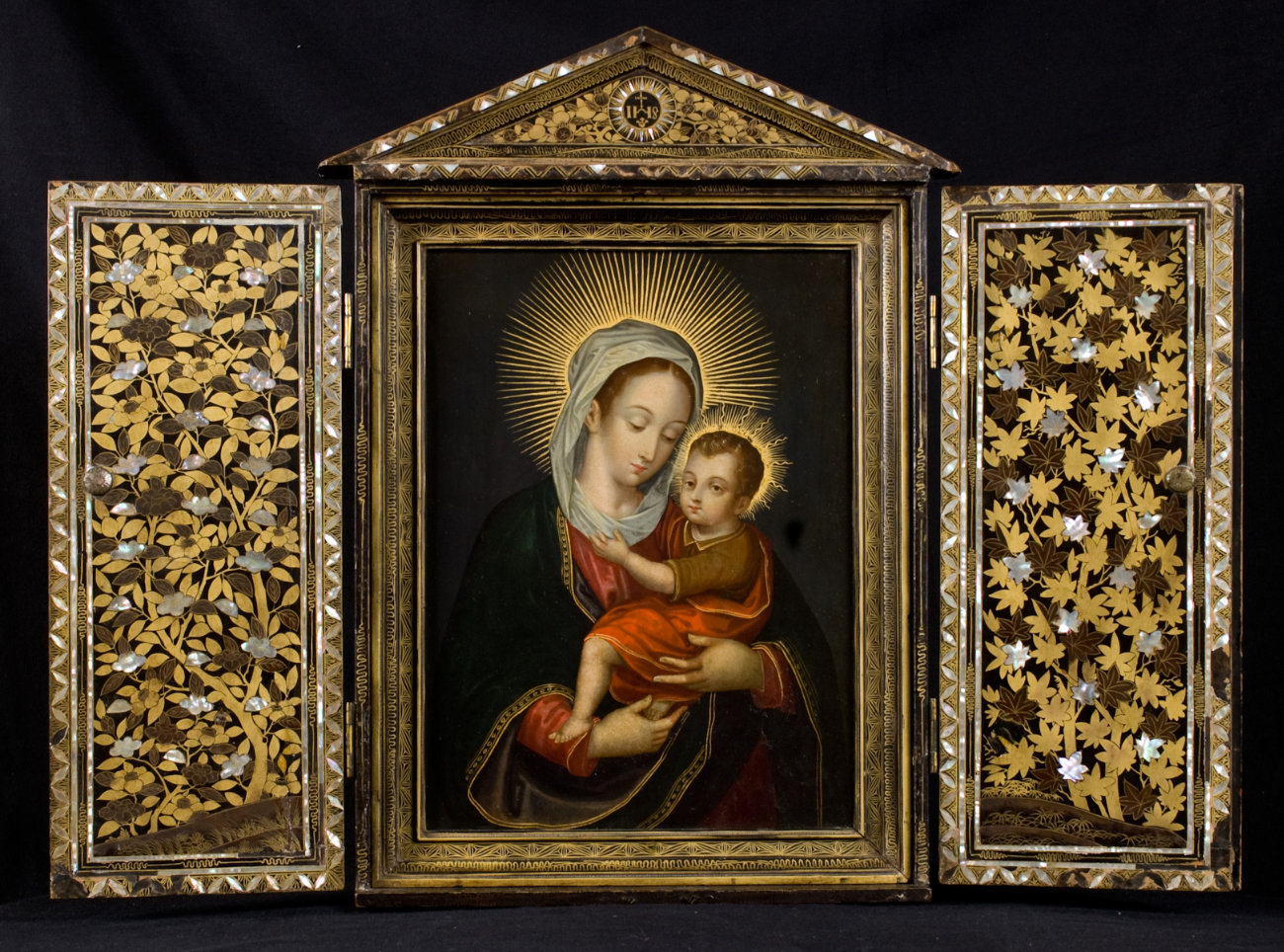
These local forms and techniques were adapted to missionary Catholic ends in Nanban lacquer shrines, which developed a distinct decorative aesthetic. Lacquer artisans reconfigured traditional zushi (portable shrines) to create versions designed for export to house Christian devotional images.14 An early example now held at the Santa Casa da Misericórdia in the Portuguese town of Sardoal features hinged doors beneath a roofed gable; enshrined inside is an oil-on-copper painting of the Virgin and Child (fig. 1).15 The sacrality of the icon is both affirmed and delineated through the use of Japanese techniques and seasonal motifs in an ornamental capacity: The gable and the inner faces of the doors, which surround the image, are densely decorated with camellias and mandarin oranges and maple trees, enclosed within geometric borders. Such seasonal floral motifs were common on Japanese religious shrines, where they carried auspicious associations.16 The Sardoal shrine’s abundant vegetal ornamentation in gold and mother-of-pearl, which carpets the black ground, is characteristic of Nanban export lacquerware. Export pieces often feature raden, a mother-of-pearl technique in which thin pieces of shell are affixed to a wooden base, leveled with layers of lacquer, and polished to reveal their iridescence. For export, workshops adopted more expedient and cost-effective methods, adding greater quantities of animal glue, reducing the number of lacquer layers, and blending native urushi with imported thitsi lacquer from Southeast Asia.17 The resulting dense, shimmering decoration catered to Iberian tastes and mirrored other export items that traveled along the Portuguese trade routes, such as Indian furniture and textiles.18
Export shrines reflected the increased mobility of sacred images amid the Counter-Reformation’s global aims. Iberian expansion and the universal Catholic missionary enterprise facilitated the circulation of religious imagery while intensifying ecclesiastical efforts to control sacred boundaries. In response to Protestant iconoclasm, the Council of Trent (1545–63) reaffirmed the instructional value of religious images yet advocated strict oversight to distinguish sacred from profane content.19 Believed to be powerful tools for proselytization across linguistic divides, the appearance, display, and use of religious images in rituals remained a constant concern in the overseas missions—especially in East Asia, where Jesuits’ accommodative strategies heightened fears that adapting Christian rituals and visual culture to foreign contexts might dilute or alter their content.20 In Japan, Jesuits imported European prints and paintings, appealing to Japanese concepts of iconicity. The mission later enlisted the Italian Jesuit painter Giovanni Cola (Niccolò) to produce religious artworks as well as to train Japanese novices in a painting seminary to replicate European models, ensuring strict control over form, style, and iconography to prevent semantic slippage.21 As Alexandra Curvelo has suggested, the Jesuit enterprise likened the copying of religious images to Christian conversion, one that, in their view, proposed a sacred transmission across cultural frontiers, materialized through a seamless process of replication and made manifest in the artworks themselves.22
The Icon Reframed
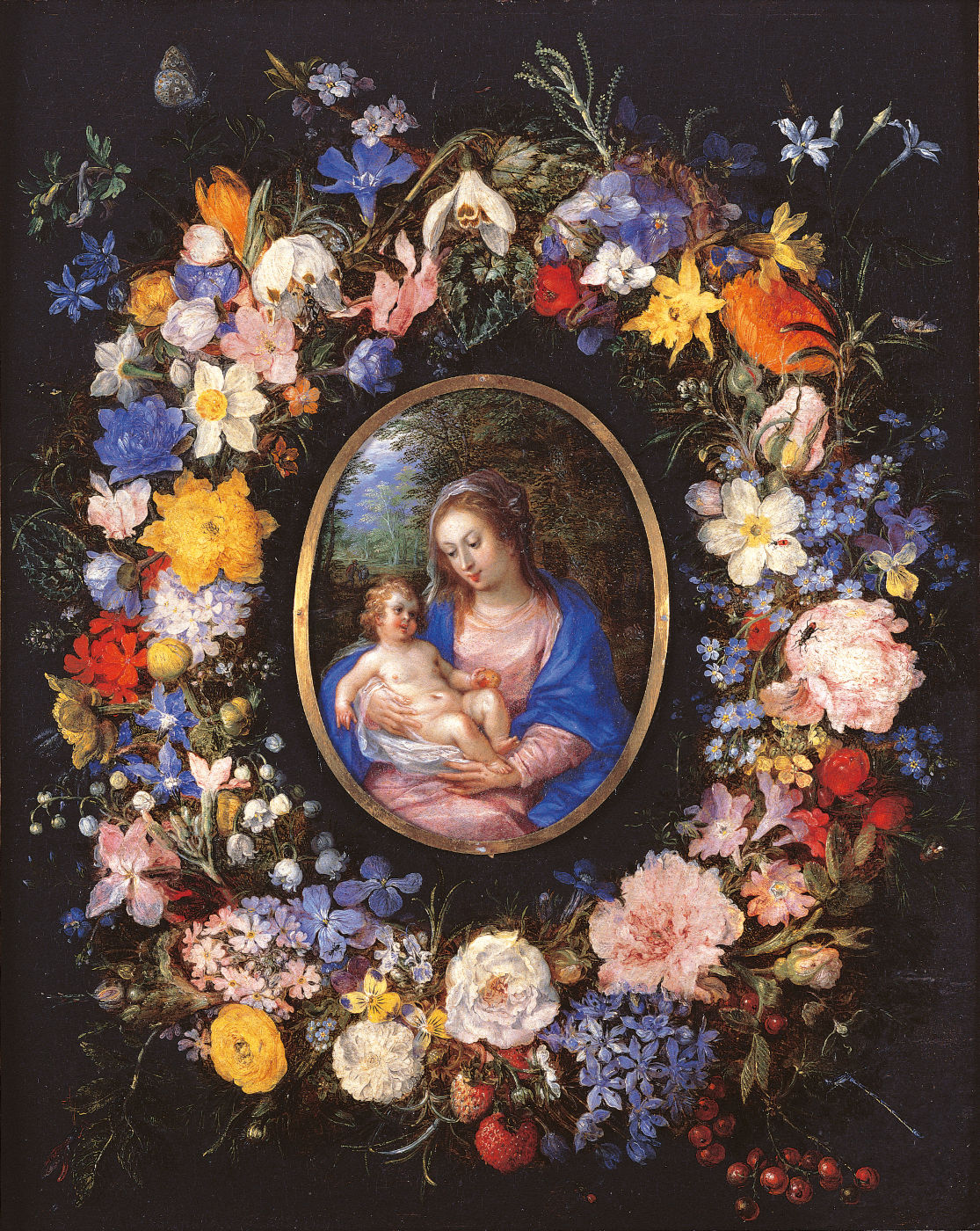
Framing strategies played a key role in seamlessly integrating religious images into the portable ornamental shrines that housed them. Export shrines could function as both physical and metaphorical framing devices for religious images, mediating shifting cultural and geographic mobilities during an era of global Catholicism and post-Tridentine regulation. In this regard, the shrines resonated with contemporaneous European “inset images” (Einsatzbilder), sacred images within ornamental frames linked to Counter-Reformation principles of decorum. This seamless integration of the image into its surrounds is evident in Flemish garland paintings, such as the 1608 collaboration between Jan Brueghel and Hendrick van Balen for Cardinal Federico Borromeo (fig. 2). Balen’s oil-on-silver Virgin and Child is framed by Brueghel’s floral garland, painted in oil on panel, emphasizing Marian themes of divine beauty and natural abundance. The composite painting employs the “smooth manner,” long championed by Netherlandish artists and theorists, a technique that conceals brushwork beneath fine layers of oil paint to evoke the image “not made by human hands.”23 This style elevated the artist’s work to the level of the divine by obscuring its manufactured origins. According to Victor Stoichita, the religious icon, set within an illusionistic frame, mediates the escalating tensions between the cult image and the authored artwork, striving to preserve its dual status as both a devotional image and a commodity within a burgeoning art market.24 Similarly, the Sardoal shrine integrates distinct artistic contributions into a seamlessly fabricated, unified artwork, merging oil-on-copper icon and lacquered ornamental frame. In doing so, it reflects a Jesuit missionary paradigm that attempted to safeguard the icon’s sacred integrity while incorporating local artistic practices and traditional Japanese floral and faunal ornamentation.
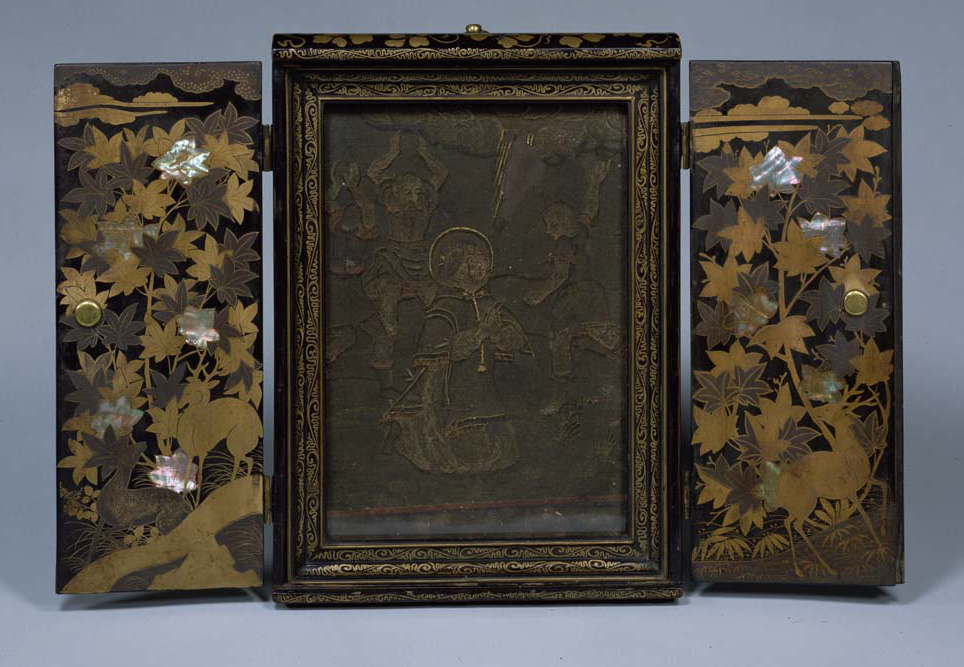
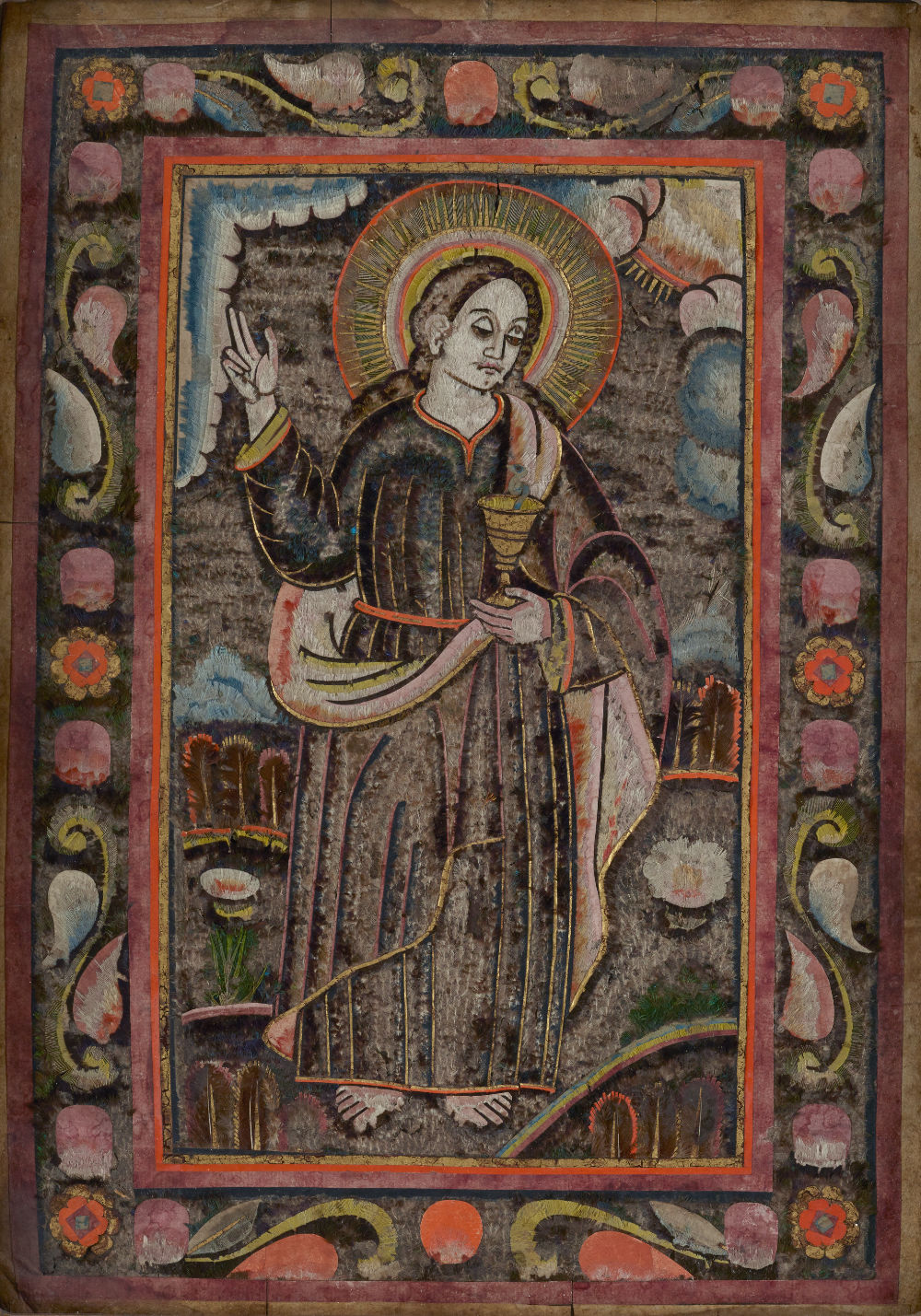
The combinatory aesthetics of the framed icon informed other types of art that traveled via the Manila Galleon route. New Spanish feather work (plumería) offers a key example. These intricate works, made from exotic bird plumage arranged into elaborate and colorful designs, had long adorned the shields and ceremonial vestments of nobles, warriors, and sacrificial victims within the Mexica (Aztec) empire. In the early decades of Spanish colonization, feather artists (known in Nahuatl as amanteca) adapted Indigenous materials and methods to produce Christian icons. By the seventeenth century, feather works had become part of a larger global trade network. The Tokyo National Museum holds an outstanding example set into a Japanese export lacquered shrine (fig. 3). Beneath a glass panel, a feather work Saint Stephen kneels in prayer beneath three assailants’ raised stones. Powdered gold and encrusted shell give shape to maple trees and deer spreading across its open hinged doors in a landscape that both frames and continues the central scene. Although the icon has lost its original brilliance, a recent technical analysis led by Hiroshige Okada at Osaka University suggests that it is a high-quality work produced in the first half of the seventeenth century.25 It showcases feathers, many of which can be identified as hummingbird, glued against paper attached to an unknown support, along with other strips of gold and colored paper.26 The feather work scene within the Tokyo shrine features a composition, style, and techniques that align with those of feather works attributed to seventeenth-century Purépecha workshops in Michoacán, such as the Saint John the Evangelist icon at the Denver Art Museum (fig. 4).27 Although the Tokyo shrine’s inserted glass panel appears machine-made and thus indicates some element of later modern intervention, there remain convincing reasons to believe that the shrine and its feather work were combined in colonial-era Mexico.28
Feather works and lacquerware circulated between Asia and the Americas throughout the early modern period. The lacquer objects discussed here show interventions along the Manila Galleon route and in Spanish colonial America. American feathers, meanwhile, were already prized in sixteenth-century Japan: In 1585, Pedro Gómez, Jesuit superior of the Japanese mission, requested from the archbishop of Évora “some small or large feathered image (imagem de pena) from the Castilian Indies,” noting their high value among the Japanese.29 This Iberian discourse on feather works ran parallel to contemporaneous discussions on lacquer. Feather artists in New Spanish Franciscan workshops created Christian images based on European prints, echoing practices from the Jesuit Japanese seminary described earlier. The amanteca also adapted their techniques for broader export markets, emphasizing specific materials and visual effects that parallel the strategies of Japanese lacquer artisans working for foreign trade.30
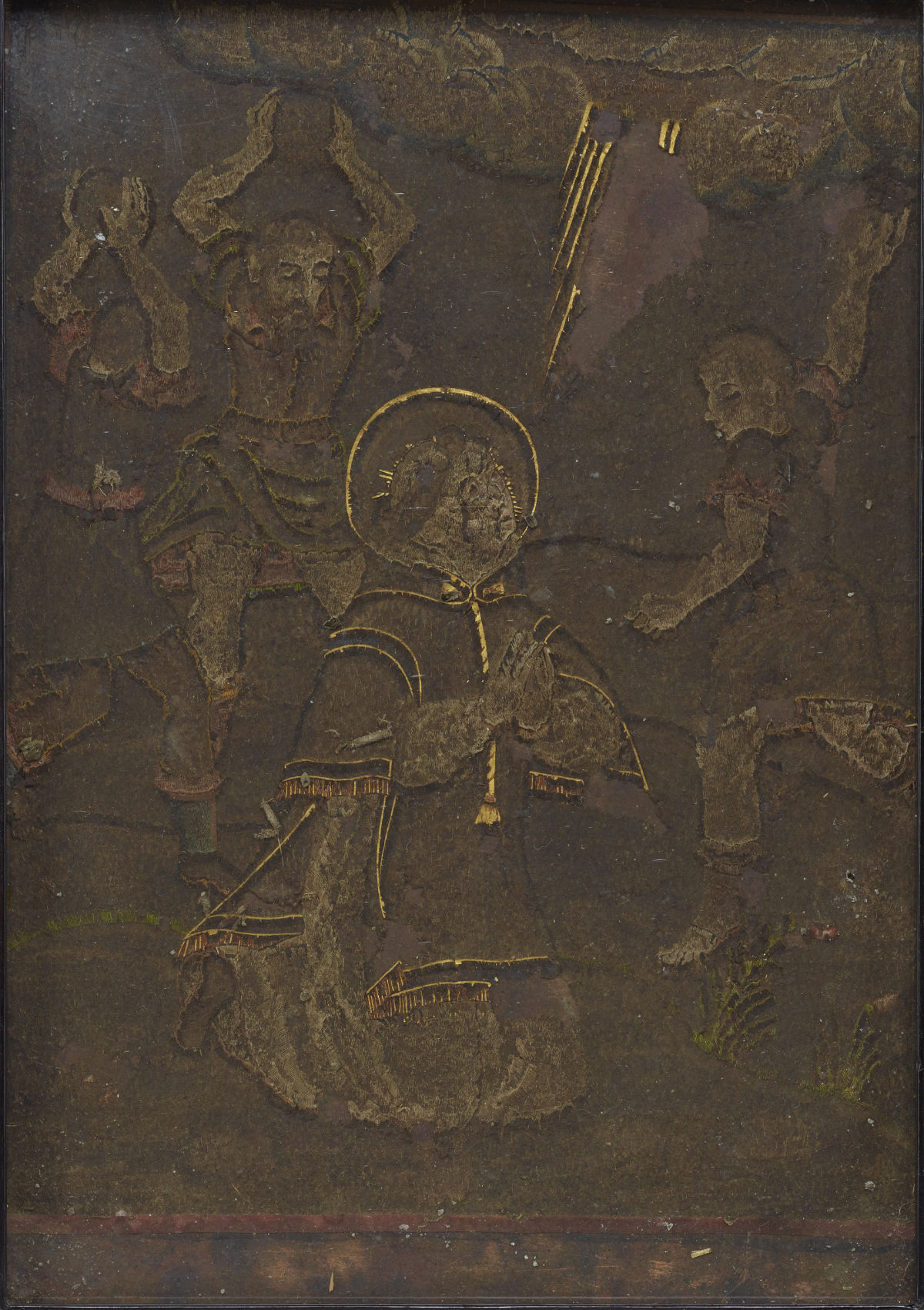
Framing appears to have been a crucial concern in colonial feather works from their earliest production.31 As Luisa Elena Alcalá has argued, feathered images attributed to the seventeenth century exhibit consistent compositions and dimensions that reflect a broader trend toward standardization in private devotional works.32 Many of these feather works display an integrated frame decorated with strips of paper and floral decorations made of incised colored feathers. The integrated frame delineates representational space and reinforces the central scene’s sacred status, recalling the dynamic that the European Einsatzbilder established between central icons and their painted floral surrounds. Alcalá also suggests that the feathered frames echo other inlay techniques that were prized for their smooth, integrative aesthetic, such as the seamless assembly of finely cut, colored stones known as pietre dure.33 In the Tokyo shrine, a rectangular frame with makie scrollwork surrounding the Saint Stephen scene conceals most of its feathered ornamental frame (today, only strips of gilt and red paper bordering can be seen at the picture’s top and bottom, fig. 5).34 The integrated frame highlights the artwork’s meticulous arrangement of precisely incised colored feathers into a unified and polished composition.
The lacquered shrine from the Tokyo National Museum effectively adds another frame to the feathered image, combining various craft techniques and elemental materials from land, sea, and air under the Christian icon’s auspices. The feathered icon’s background landscape continues onto the lacquer doors to articulate martyrdom as an act of territorial conversion, transforming the lush lacquer vegetation into consecrated ground, merging lacquer and feather work, icon and container, into a single Christian artifact. Feather clouds continue in golden makie to form a horizontal skyline on the adjacent doors, while the rolling hills transform into sprouting maple trees with stags and a doe. Local and auspicious flora and fauna in lacquer have come to frame a feathered icon that reciprocally sanctifies the landscape as a site of Christian martyrdom. It seems to reach for the Flemish garland painting’s gesture of natural abundance, anticipating the garlands as emblems of a nature tamed by artistic skill, blooms harvested and arranged into luxurious ornaments of devotion—in this case, Japanese vegetation primed to serve as the missionary project’s newest garden for a growing faith.
Smooth Skills
Framing dynamics deployed in lacquer and feathers partook of a broader strategy in missionary artistic rhetoric. Sources on the Iberian reception of lacquerware and feather work emphasize smooth facture as a wondrous, quasi-miraculous, artisanal achievement, yet they also underscore how this appearance of seamlessness often derived, paradoxically, from the concealment of the hands that had accomplished it.
The Spanish Jesuit missionary and natural historian José de Acosta (1540–1600) commented on colonial feather works in terms strikingly similar to his Portuguese contemporary Fróis:
In New Spain, there is an abundance of birds with excellent plumage, whose delicacy cannot be found in Europe, as can be seen from the feather pictures that come from there . . . a work so delicate and so smooth [tan delicada, y tan ygual] that it seems to be painted in colors that even the brush and dyes cannot surpass.35
Acosta establishes a paragone (comparison) in which feather work surpasses painting’s illusionistic potential. He describes the smoothness of the work using the term igual, emphasizing the uniform surface of densely packed feathers. Both Fróis and Acosta praise the skillful assembly of disparate parts into a unified surface, a discourse familiar to many European arts of the sixteenth century.36 As a missionary order, the Jesuits emerged as fervent chroniclers of the “non-manufactured” image, their words tracing an evolving rhetorical vocabulary of facture that intertwined with the Jesuits’ global pursuits in antiquarianism and natural history.37 The prizing of seamless manufacture would eventually extend into a notion of “assemblage” writ large, with arts from different kingdoms merging into a single artwork.
Moreover, “seamlessness” could describe a facture so perfect that it might even trick the eyes, yielding a visual impression that might be confirmed by the tactile effect of “smoothness.” Acosta recalls how Pope Sixtus V tested the surface of a feathered image representing Saint Francis, which he had been gifted, by “softly passing his fingers over the picture to see if it was indeed made of feathers. He thought it marvelous that they were so well set [within the picture] that sight could not determine whether they were natural colors of feathers or artificial colors painted with a brush.”38 For Acosta, the determinative capabilities of touch surpass those of vision. At first glance, the densely arrayed feathers confound discernment between nature and artifice.39 For both Acosta and Fróis, the object’s surface mediates sensory contemplation of its own manufacture while never fully disclosing the fabrication process. Fróis describes the lacquer object in similar terms, emphasizing the secrecy of its making.
Jesuit missionaries recognized in Japan the familiar elements of a stratified society with its own artisanal class, the shokunin. Not unlike the European guilds, artisanal production in Japan was generally a generational, familial, and male-led enterprise (known as ie, “household”), administered by a master craftsman whose knowledge was carefully safeguarded and transmitted only to workshop members.40 Eiko Ikegami describes the shokunin’s skill or mastery (gei or geinō) as a magical technology or ability “to move or influence nature and to connect this present world with the unseen world beyond.”41 The Japanese lacquerer’s ability to not just transform toxic sap into a hard, smooth surface but also to integrate brilliant materials, aligns with the shokunin’s near-magical harnessing of natural forces and ties to the spiritual realm. Comparatively, the amanteca’s artful use of iridescent feathers was associated with a spiritual essence, known in Nahuatl as tonalli, and was later adapted to Christian imagery.42 Indeed, praised by Catholic missionaries, the invisible handiwork of lacquerers and feather artists was conditioned by a careful balance between revealing and concealing, between the mastery and mystery of their artistry.43 The missionaries’ noted admiration of a non-European technique went beyond neutral aesthetic appreciation; it reflected a desire to access the artisan’s secret, even magical knowledge, and repurpose it for global aims. Whether in Fróis’s praise of lacquer as a reliquary or Acosta’s account of feather work transformed into a Christian icon, both missionaries attested to the sacred efficacy embedded in these artistic media.
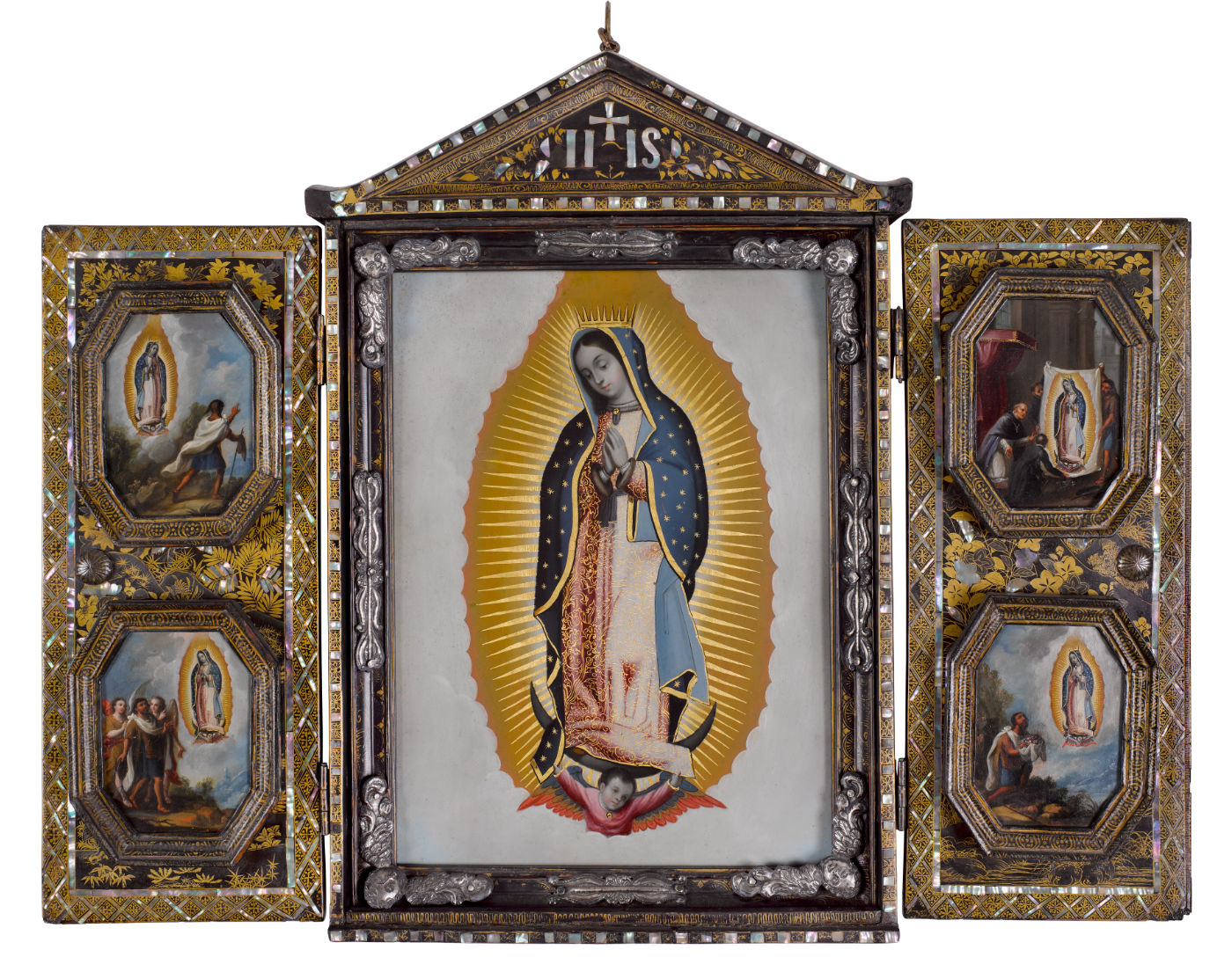
The dynamic interplay of revelation and concealment inherent in the seamless surface persisted through the transpacific circulation of religious art well into the eighteenth century.44 An export lacquer shrine from the Daniel Liebsohn Collection in Mexico City speaks to the continuation of this phenomenon between the Americas and Asia via the Manila Galleon circuit (fig. 6). The shrine’s lacquered doors open to reveal a striking visual palimpsest: a resplendent eighteenth-century oil-on-copper painting of the Virgin of Guadalupe embedded within a seventeenth-century Japanese lacquer shrine, itself imported a century earlier. Affixed to the rear of the shrine is an inscribed piece of paper, an indulgence granted to those who pray before the image, issued by the bishop of Calahorra and La Calzada and dated November 15, 1786, in the Basque town of Mondragón (Gipuzkoa).45 This Atlantic addition overlays yet another vector of circulation upon the shrine’s Pacific trajectories. The gifting of Guadalupe images to Basque-speaking regions was a common colonial practice, reflecting the enduring ties between Basque emigrants to New Spain and their home communities in Northern Spain.46 The shrine once again merges diverse artistic traditions, while also reflecting the continued preservation and reuse of export lacquerware in the colonial period.
Cherubim wrought in American silver surround the central icon, accompanied by four small painted scenes of the Virgin’s miraculous apparition, affixed to the lacquer doors. Following period protocols for depicting the Guadalupe, they sequentially capture her apparition to the Indigenous witness Juan Diego and her command to gather roses in his cloak. Appearing before Mexico’s first bishop, Diego spills the flowers to reveal the Virgin’s image miraculously impressed into the cloth. By the seventeenth century, the apparition narrative had supplanted the account of an Indigenous painter Marcos Cipac de Aquino’s authorship, reflecting the imposed layering that shaped artistic production in New Spain: a Catholic icon materialized in an Indigenous substrate—a cloak (tilma) of ayate (ayatl) cloth woven from local maguey or palm fibers. In the Liebsohn shrine, floral decoration and painted scenes engender a missionary myth of seamless overlay.
As recently explored by Derek S. Burdette, viceregal artists served as the prime investigators in determining the Guadalupe’s divine origins.47 The artists who inspected the image in the seventeenth and eighteenth centuries insisted on the miraculous nature of the surface’s painted smoothness, in specific contrast with the “roughness” of the native ayate fabric.48 For example, the famed New Spanish painter Miguel Cabrera emphasized its miraculous smoothness in his Maravilla americana, an examination of the picture published in 1756, drawing deeply on Jesuit discourse that framed the image as a divine imprint beyond human artistry.49 He writes:
What should provoke admiration is the softness [suavidad] experienced in this ayate; for all the roughness it presents to the eye, which one would expect from being made of such ordinary material, is converted to the touch into a gentle smoothness very similar to that of fine silk, as I have found on the many occasions I have had the good fortune to touch it; and certainly the other ayates of its kind do not enjoy this privilege.50
Cabrera describes the “ordinary matter” of the cloth as a rough and crude ground transformed into a soft, painted surface. He thus witnesses the miracle through the tactile experience of its conversion from roughness into smoothness. The smooth, seamless surface affirms the image’s divine creation while simultaneously concealing the “roughness” of Native craft, and, by extension, its Indigenous authorship.51
In closing, it is worth noting that in seeking to describe the tactile effects of the Guadalupe’s miraculous materiality, Cabrera opted for a comparison to the handmade commodity of fine silk. Asian export silk, a lifeblood of transpacific commerce, unfurled across colonial society to adorn its interiors and bodies alike. Like lacquer, silk’s shining surface captured the Iberian imagination of wonderfully seamless, effortless manufacture. Yet beneath this smoothness lay the entangled histories of transpacific labor and the many skilled hands that shaped such artworks’ sheen. The rhetoric of seamlessness enabled these objects to inhabit disparate, yet increasingly interconnected, cultural systems of value.52 That miraculous facture could be seamlessly converted from the acheiropoieton to the merchandise item announces the object’s new commodified status on the eve of the industrial age. Where commerce and religion intersect, the sacred does not so much disappear as become appropriated and generalized within the world of goods, consumption practices, and tastes—surface, in turn, emerges as the primary site for a modern aesthetic judgment sustained by imperceptible labor. In this interplay of revelation and concealment, one glimpses a defining paradox of the early modern world in which artisanal skill was both desired and dissimulated within global imperial economies, outshined by the gleam of an immaculate facade.
Notes
-
Luís Fróis, História de Japam, ed. José Wicki, SJ, vol. 5, cap. 50, “Da carta que Quambaco escreveu ao Vice-Rei e do presente que lhe mandou” (Biblioteca Nacional, 1976–84), 378–79. Translations by the author, unless otherwise noted. ↩︎
-
See Oliver Impey and Christiaan Jörg, Japanese Export Lacquer: 1580–1850 (Hotei, 2005); Hidaka Kaori, Ikoku no hyōshō: Kinsei yushutsu shikki no sōzōryoku (Brücke, 2008); Samuel Luterbacher, “Surfaces for Reflection: Nanban Lacquer in the Iberian World,” Journal of Early Modern History 23, no. 2–3 (2019): 152–90. ↩︎
-
Fróis, História, 378–79. See also Luterbacher, “Surfaces for Reflection,” 152–55. ↩︎
-
See Kanki Keizō, “Iberia-kei seiga kokunai ihin ni miru chihō yōshiki,” Bijutsushi, no. 126 (1989): 151–72; Meiko Nagashima, “Japanese Lacquers Exported to Spanish America and Spain,” in Asia and Spanish America: Trans-Pacific Artistic and Cultural Exchange, 1500–1850: Papers from the 2006 Mayer Center Symposium at the Denver Art Museum, ed. Donna Pierce and Ronald Otsuka (Mayer Center for Ancient and Latin American Art at the Denver Museum of Art, 2009), 107–18; Luterbacher, “Surfaces for Reflection,” 152–90; Okada Hiroshige, “Sakuhin to chōsa no gaiyō,” in Kogakuteki kagaku chōsa o jiku to shita shoki yōfūga to Ajia Taiheiyō kaiiki bijutsu kōtsū ni kansuru kibanteki kenkyū hōkokusho, ed. Okada Hiroshige, vol. 1 Honpen (Osaka Daigaku Jinbun Kagaku Kenkyūkanai Bijutsushigaku, 2025), 8–13. ↩︎
-
See Brendan C. McMahon, “Contingent Images: Looking Obliquely at Colonial Mexican Featherwork in Early Modern Europe,” The Art Bulletin 103, no. 2 (2021): 24–49; Charlene Villaseñor Black, “The Iridescent Enconchado,” in Iberian Empires and the Roots of Globalization, ed. Ivonne del Valle, Anna More, and Rachel Sarah O’Toole (Vanderbilt University Press, 2019), 233–70. ↩︎
-
Martin Kemp, “‘Wrought by No Artist’s Hand’: The Natural, the Artificial, the Exotic, and the Scientific in Some Artifacts from the Renaissance,” in Reframing the Renaissance: Visual Culture in Europe and Latin America, 1450–1650, ed. Claire Farago (Yale University Press, 1995), 177–96. ↩︎
-
See Joseph Leo Koerner, “Factura,” Res: Anthropology and Aesthetics, no. 36 (1999): 5–19; Alessandra Russo, A New Antiquity: Art and Humanity as Universal, 1400–1600 (Pennsylvania State University Press, 2024), 128–64. ↩︎
-
See Russo, A New Antiquity. ↩︎
-
Dennis O. Flynn and Arturo Giráldez, “Born with a ‘Silver Spoon’: The Origin of World Trade in 1571,” Journal of World History 6, no. 2 (1995): 201–21. ↩︎
-
On the occlusion of artistic or labor processes under colonial conditions, see Sara Ryu, “Molded and Modeled: Sculptural Replication in the Early Modern Transatlantic World,” in At the Crossroads: The Arts of Spanish America and Early Global Trade, 1492–1850, ed. Donna Pierce and Ronald Otsuka (Mayer Center for Ancient and Latin American Art at the Denver Art Museum, 2012), 121–22. ↩︎
-
On this, see Hélène Vu Thanh, “Poverty, Finances and Evangelization: The Case of the Jesuit Mission in Japan (16th–17th Centuries),” Bulletin of Portuguese/Japanese Studies, 2nd ser., vol. 5 (2022): 29–46. ↩︎
-
Luterbacher, “Surfaces for Reflection,” 174–75. See also Kiichi Matsuda, Kinsei shoki Nihon kankei Nanban shiryō no kenkyū (Kazama Shobō, 1967), 1022–45; and Rie Arimura, “Escenario de las producciones del arte kirishitan (1549–1639): la contribución de los artífices japoneses a la conformación de un fenómeno intercultural,” Hispania 55 (2011): 52–54. ↩︎
-
On the guild system in colonial Goa, see Teotonio R. de Souza, Medieval Goa: A Socio-Economic History (Broadway Book Centre, 2009), 123–29. ↩︎
-
Chu Wa Chan, “The Concept of Zushi: On Enshrinement and Mobility of Buddhist Art in Japan,” Japanese Religions 43 (2018): 17–37. ↩︎
-
On this work, see Alexandra Curvelo, “Oratório Namban,” in Discover Baroque Art, Museum With No Frontiers, 2025, https://baroqueart.museumwnf.org/database_item.php?id=object;BAR;pt;Mus11_A;3;pt. ↩︎
-
Andrew M. Watsky, “Floral Motifs and Mortality: Restoring Numinous Meaning to a Momoyama Building,” Archives of Asian Art 50 (1997): 62–92. ↩︎
-
See Clement Onn, “Circulating Art and Visual Hybridity: Cross-Cultural Exchanges Between Portugal, Japan, and Spain,” Renaissance Studies 34, no. 4 (2020): 624–49. ↩︎
-
Hidaka, Ikoku no hyōshō, 57–61. ↩︎
-
See Alfonso Rodríguez G. de Ceballos, “Image and Counter-Reformation in Spain and Spanish America,” in Sacred Spain: Art and Belief in the Spanish World, ed. Ronda Kasl and Alfonso Rodríguez G. de Ceballos (Yale University Press, 2009), 15–36. ↩︎
-
On this topic, see Joan-Pau Rubiés, “The Concept of Cultural Dialogue and the Jesuit Method of Accommodation: Between Idolatry and Civilization,” Archivum Historicum Societatis Iesu 74, no. 147 (2005): 237–80. ↩︎
-
Alexandra Curvelo, “Copy to Convert: Jesuits’ Missionary Practice in Japan,” in The Culture of Copying in Japan: Critical and Historical Perspectives, ed. Rupert Cox (Routledge, 2008), 111–27. ↩︎
-
Ibid. ↩︎
-
Christopher S. Wood, “‘Curious Pictures’ and the Art of Description,” Word & Image 11, no. 4 (1995): 332–34; Koerner, “Factura,” 5–19. ↩︎
-
Victor I. Stoichita, L’Instauration du tableau: Métapeinture à l’aube des temps modernes (Droz, 1999), 116–20. ↩︎
-
See Okada, “Sakuhin to chōsa no gaiyō,” 8–13. ↩︎
-
María Olvido Moreno Guzmán, “Mosaico plumario del Martirio de san Esteban. Una aproximación a su manufactura,” in Kogakuteki kagaku chōsa, 52–66. ↩︎
-
See Allison Caplan, “The Cotinga and the Hummingbird: Material Mobilities in the Early Colonial Featherwork of New Spain,” in The Routledge Companion to Global Renaissance Art, ed. Stephen J. Campbell and Stephanie Porras (Routledge, 2024), 482–99. ↩︎
-
The artwork was purchased at an auction in New York in 1980 and entered the Tokyo National Museum’s collection two years later. See Okada, “Sakuhin to chōsa no gaiyō,” 8–13. See also, Okada Hiroshige, Fukushima Osamu, Miyata Masahiro, “CT sukyan gazō satsuei no kekka to shoken,” in Kogakuteki kagaku chōsa, 26–30. ↩︎
-
Cartas que os padres e irmãos de Companhia de Jesus escreverão dos reynos de Iapão e China . . ., book 1, part 2 (Évora, 1598), 168. ↩︎
-
As Caplan has demonstrated, the use of tropical bird plumage declined in the late sixteenth century, supplanted by more seasonally available species like the hummingbird to meet growing colonial export markets. See Caplan, “The Cotinga and the Hummingbird,” 482–99. ↩︎
-
On this topic, see Barbara Mundy, The Death of Aztec Tenochtitlan, the Life of Mexico City (University of Texas Press, 2015),105–7. ↩︎
-
Luisa Elena Alcalá, “Reinventing the Devotional Image: Seventeenth-Century Feather Paintings,” in Images Take Flight: Feather Art in Mexico and Europe, 1400–1700, ed. Alessandra Russo, Gerhard Wolf, and Diana Fane (Hirmer, 2015), 386–405. ↩︎
-
Ibid. ↩︎
-
The CT scan reveals that the picture was inserted with a slight tilt to fit the shrine, which is visible in the unstraight bands of paper at the top and bottom. See Okada et al., “CT sukyan,” 26–30. ↩︎
-
José de Acosta, Historia natural y moral de las Indias, vol. 4 (Juan de León, 1590), 284–85. ↩︎
-
Rensselaer W. Lee, Ut Pictura Poesis: The Humanistic Theory of Painting (W. W. Norton, 1967), 9–22. ↩︎
-
See Marc Fumaroli, “De l’icône en négatif à l’image rhétorique: Les autoportraits du Christ,” in L’immagine di Cristo: Dall’acheropita alla mano d’artista; Dal tardo medioevo all’età barocca, ed. Christoph L. Frommel and Gerhard Wolf (Biblioteca Apostolica Vaticana, 2006), 413–48. On these missionary interminglings of devotion and natural history, see Lea Debernardi, “Finding Christ in Roots and Seeds: Crucifixes Produced by Nature in Quaresmio’s Terrae Sanctae Elucidatio,” Mediterranean Historical Review 38, no. 2 (2023): 251–71. ↩︎
-
Acosta, Historia natural, 285. ↩︎
-
Kemp, “‘Wrought by No Artist’s Hand,’” 177–96. ↩︎
-
See Christine M. E. Guth, Craft Culture in Early Modern Japan: Materials, Makers, and Mastery (University of California Press, 2021). ↩︎
-
Eiko Ikegami, Aesthetic Networks and the Political Origins of Japanese Culture, Structural Analysis in the Social Sciences (Cambridge University Press, 2005), 82. ↩︎
-
Alessandra Russo, “Plumes of Sacrifice: Transformations in Sixteenth-Century Mexican Feather Art,” Res: Anthropology and Aesthetics 42 (2002): 226–50. ↩︎
-
Glenn Adamson, The Invention of Craft (Bloomsbury, 2013), 53–126. ↩︎
-
Another trajectory related to seamless facture is the ivory carvings of Chinese migrants in Manila, such as a crucifix from the Dominican monastery of San Esteban in Salamanca with an ivory Christ on a Nanban lacquer cross. ↩︎
-
María Isabel Astiazarain, “La iconografía de la Virgen de Guadalupe. Dos cuadros de Miguel Cabrera en Guipúzcoa,” Cuadernos de Arte Colonial, no. 7 (1991): 139–49. ↩︎
-
On this topic, see Juan Javier Pescador, The New World Inside a Basque Village: The Oiartzun Valley and Its Atlantic Emigrants, 1550–1800 (University of Nevada Press, 2003). ↩︎
-
Derek S. Burdette, “The Power of Expertise: Artists as Arbiters of the Miraculous in New Spain,” in Collective Creativity and Artistic Agency in Colonial Latin America, ed. Maya Stanfield-Mazzi and Margarita Vargas-Betancourt (University Press of Florida, 2023), 107–36. ↩︎
-
Ibid., 120. ↩︎
-
Jaime Cuadriello, “Zodiaco mariano, una alegoría de Miguel Cabrera,” in Zodiaco Mariano, 250 años de la declaración pontificia de María de Guadalupe como patrona de México, ed. Jaime Cuadriello (Museo de la Basílica de Guadalupe/Museo Soumaya, 2004), 9–129. ↩︎
-
Miguel Cabrera, Maravilla americana (Imprenta Real, 1756), 4. ↩︎
-
See Luisa Elena Alcalá, “The Image and Its Maker: The Problem of Authorship in Relation to Miraculous Images in Spanish America,” in Sacred Spain: Art and Belief in the Spanish World, ed. Ronda Kasl (Yale University Press, 2009), 56. ↩︎
-
I draw here on William Pietz’s discourse of the fetish, rooted in early modern encounters between the Portuguese and West African societies. See William Pietz, The Problem of the Fetish, ed. Francesco Pellizzi, Stefanos Geroulanos, and Ben Kafka (The University of Chicago Press, 2022). ↩︎